


Time is one of the most consequential financial inputs in an agency, yet it is often treated as an administrative task.
When hours are entered late, assigned to the wrong job, or managed separately from financial data, the impact extends far beyond incomplete timesheets. WIP can be misstated. Project margins can appear healthier than they are. Billing decisions can be made using incomplete information. Resource forecasts can be based on capacity that does not actually exist.
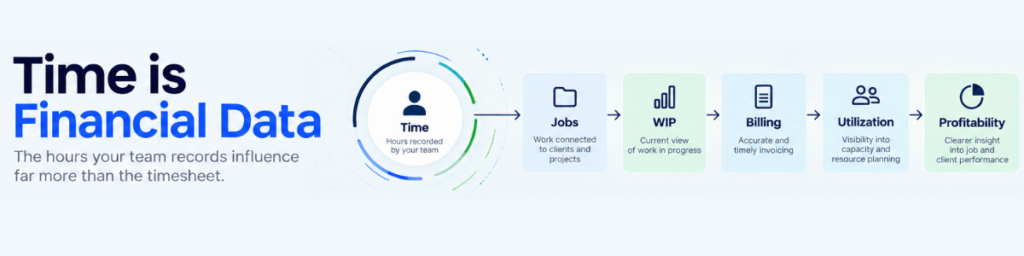
Agency time tracking is therefore not simply about recording hours. It is about creating reliable financial data that connects the work people perform to jobs, billing, WIP, utilization, and profitability.
What Is Agency Time Tracking?
Agency time tracking is the process of recording employee time against clients, jobs, projects, and internal activities so an agency can understand how its people are being utilized and how labor affects financial performance.
Those hours have consequences beyond the timesheet. Time influences job costs, WIP, client billing, utilization, resource requirements, and ultimately job and client profitability.
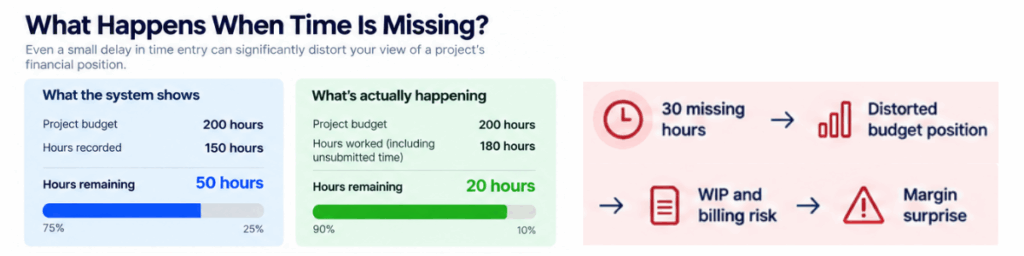
Consider a client project budgeted for 200 hours.
The team has actually worked 180 hours, but only 150 have been entered. Based on the available time data, the project appears to have 50 hours remaining.
In reality, only 20 remain.
That 30-hour difference can change decisions about staffing, scope, billing, WIP, and expected margin.
The problem is not simply that a few timesheets are incomplete. The agency is making financial decisions using incomplete information.
Why Time Tracking Matters to Agency Finance
Most agencies sell some combination of expertise, capacity, and time. Even when clients are billed through fixed fees, retainers, commissions, or other pricing models, the labor required to deliver that work remains a significant part of its economics.
That makes time data relevant far beyond utilization reporting.
A finance or operations leader may need to know:
- Which clients and jobs are consuming more hours than expected?
- Are project budgets based on realistic delivery assumptions?
- Is higher utilization translating into higher profitability?
- Where is scope expanding without a corresponding increase in revenue?
- Does finance have complete information when reviewing WIP and billing?
- Does the agency have enough capacity for forecast work?
A CFO reviewing client profitability needs to understand both sides of the equation: what the agency earned and what it took to deliver the work.
Without reliable time data connected to the underlying jobs, that picture is incomplete.
Why Standalone Time Tracking Creates a Financial Data Gap
A standalone time-tracking application can answer a relatively simple question:
How many hours did someone work?
Agency finance needs to answer a more consequential question:
What did those hours mean financially?
Suppose an employee records 10 hours.
On its own, that number says relatively little. Finance needs the context around it.
Which client was the work for? Which job? Was it billable? How much time had been budgeted? What other labor has already been charged to the job? How does the additional time affect WIP, billing, and expected margin?
When time is captured in one application, project budgets are maintained somewhere else, billing happens in another system, and finance calculates WIP separately, the agency has to reconstruct those relationships.
The problem is not the timesheet itself. It is the separation between time data and financial data.
Connect Time Directly to Clients, Jobs, and Budgets
For an agency, the job should connect the work employees perform with the financial results finance reports.
When someone records six hours against a client job, those hours should become part of that job’s financial history.
That creates a connected flow:
Budgeted hours → Actual hours → Job cost → WIP and billing → Margin
This becomes particularly important when an agency manages multiple jobs for the same client.
A client can appear profitable overall while individual jobs are moving in very different directions. One engagement may be performing ahead of plan while another consumes substantially more labor than estimated.
Job-level time data helps finance and operations identify that difference before an underperforming engagement disappears inside the client’s overall results.
Utilization Is Not the Same as Profitability
Utilization matters, but high utilization does not automatically mean profitable work.
A team can be highly utilized while working on jobs that are over budget, poorly priced, or absorbing unplanned scope.
Conversely, lower utilization does not automatically indicate a performance problem. It could reflect planned new-business activity, internal investment, training, or capacity being maintained for upcoming work.
The more useful financial question is:
What result is the agency generating from the time being used?
This is why utilization is more valuable when analyzed alongside job budgets and profitability.
A finance leader should be able to see not only that people are busy, but whether the work consuming that capacity is producing the financial outcome the agency expected.
Accurate Time Improves WIP and Billing Decisions
Time data also becomes particularly important during WIP and billing reviews.
Consider a finance team beginning its month-end review while employees still have material amounts of unsubmitted time.
A job may appear to be within budget because the latest labor has not reached the financial record. Finance may make a billing or WIP decision using that incomplete picture, only to discover the additional hours later.
Time tells the agency what work occurred. WIP helps finance understand the financial position of that work.
When those processes are connected, finance has a more current basis for reviewing jobs instead of reconstructing what happened after the fact.
Better Time Data Improves Forecasting
The value of time data does not end when a project closes.
Historical job data can help agencies improve future estimates, staffing plans, pricing decisions, and resource forecasts.
Consider an agency that routinely estimates 400 hours for a particular type of engagement.
If completed jobs consistently require closer to 500 hours, that variance should influence how the next engagement is scoped and priced.
Reliable job-level time data can help leaders understand:
- How much labor different types of work actually require
- Where estimates consistently differ from delivery
- Which clients or services consume disproportionate resources
- How much capacity upcoming work is likely to require
- Whether pricing reflects the actual effort needed to deliver the work
This is where time tracking becomes more than historical recordkeeping.
Past delivery data becomes an input into future financial decisions.
Time Tracking Has to Work Where Agency Teams Work
None of this works particularly well if entering time is difficult.
Agency employees may move between client meetings, remote work, production shoots, travel, and multiple engagements during the same day. The longer employees wait to reconstruct that activity, the greater the opportunity for time to be missed or assigned incorrectly.
That is why accessibility matters.
The Counta Mobile App by Accountability allows employees to enter time and expenses from a mobile device instead of relying exclusively on desktop workflows.
The financial benefit is straightforward:
Easier entry → More timely time data → More current job information → Better financial visibility
The objective is not simply to make timesheets more convenient. It is to reduce the lag between when agency work happens and when that activity becomes visible in the agency’s financial system.
AI Is Changing How Agencies Interact With Time Data
AI introduces another way for agency teams to interact with financial information, but its usefulness depends heavily on the structure of the underlying data.
Consider a CFO asking:
Which client jobs have exceeded their planned hours this month, and what has happened to their margins?
Answering that question requires considerably more than access to a collection of timesheets.
The AI needs context around clients, jobs, budgets, employees, time, costs, billing, and profitability.
This is where the financial system of record becomes increasingly important.
The Counta AI Connector allows supported AI tools to interact with structured agency data in Accountability. Agency teams can use AI to analyze financial and operational information and, within supported permissions and workflows, create or update time entries back in Accountability.
AI becomes another way of interacting with the agency’s financial information rather than another disconnected place where financial data lives.
One Financial System, Multiple Ways to Work
Modern agency finance does not necessarily mean forcing everyone into the same interface.
Different users need different ways to interact with financial information.
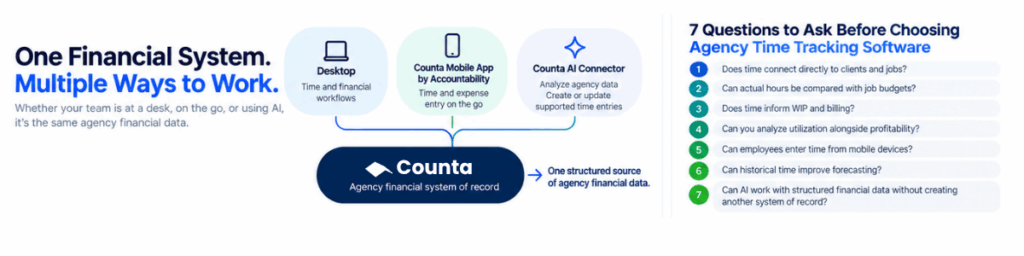
An employee may enter time from a desktop.
Someone traveling may use the Counta Mobile App by Accountability to enter time or expenses.
An authorized user may interact with agency data through an AI environment using the Counta AI Connector.
What matters is what sits underneath those experiences.
Counta remains the agency financial system of record.
Time, jobs, WIP, billing, expenses, and other financial information remain connected rather than being recreated across separate systems.
What Should Agencies Look for in Time Tracking Software?
Choosing agency time tracking software should involve more than comparing timesheet interfaces.
Finance and operations leaders should ask whether the underlying system can turn recorded hours into useful financial information.
The seven questions in the graphic above provide a useful starting point:
- Does time connect directly to clients and jobs?
- Can actual hours be compared with job budgets?
- Does time inform WIP and billing?
- Can utilization be analyzed alongside profitability?
- Can employees enter time from mobile devices?
- Can historical time improve forecasting?
- Can AI work with structured financial data without creating another system of record?
These questions expose an important distinction between systems.
Some systems collect time.
Others allow agencies to use time as financial information.
A Different Approach to Agency Time Tracking
Counta is built specifically around the financial and operational structure of agencies.
Within Accountability, time is connected with clients, jobs, expenses, WIP, billing, revenue, resource planning, and the financial information agency leaders use to understand performance.
The Counta Mobile App by Accountability extends that environment to mobile time and expense entry.
The Counta AI Connector extends the financial system of record into supported AI environments, giving authorized users another way to interact with structured agency financial data and supported workflows.
The technology used to interact with financial information will continue to change.
The underlying financial requirement does not.
Reliable financial decisions require reliable agency data.
For agencies evaluating time-tracking technology, the question is no longer simply:
Can the system record hours?
A more useful question is:
What can the agency do with those hours once they have been recorded?
See Agency Time Tracking in Action
See how Counta connects time with jobs, WIP, billing, resource planning, profitability, mobile workflows, and AI within a financial platform built specifically for agencies.
