


Why financial platforms must change before AI can deliver
Executive Summary
The next evolution of agency finance is already underway. Every significant advance in finance has changed the role of the finance function.
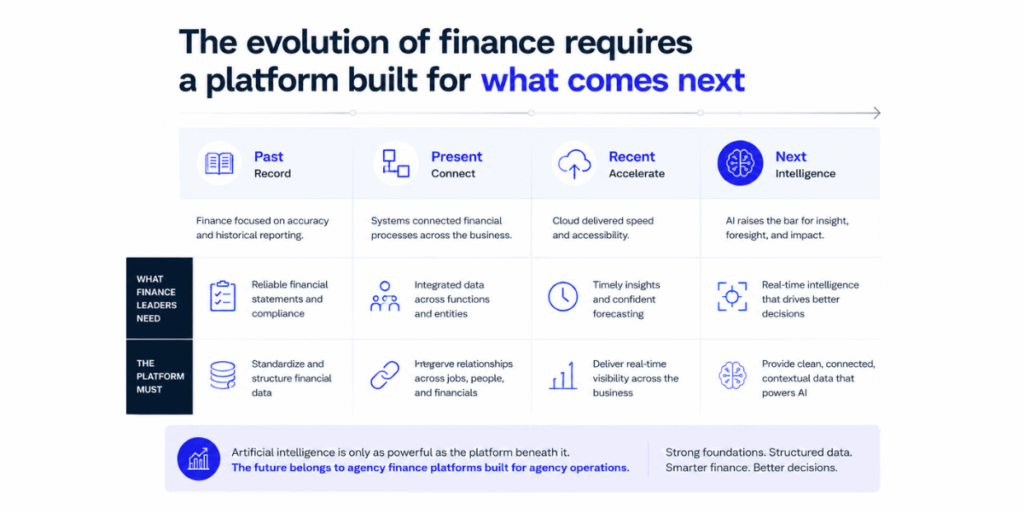
The general ledger standardized accounting. Enterprise Resource Planning (ERP) systems connected financial processes across increasingly complex organizations. Cloud computing made financial information more accessible, reducing the time between transactions and decision-making.
Artificial intelligence is driving the next evolution, but not for the reason many organizations believe.
The conversation has focused almost entirely on what AI can do. The more important question is whether the financial platforms beneath it are capable of supporting the future finance leaders are being asked to deliver.
At Accountability, we’ve spent years building a financial platform around a simple belief: agency finance is fundamentally different from every other industry. Long before AI became the centrepiece of every software roadmap, we believed agencies needed a financial platform built around agency operations, not one adapted from generic ERP software. Today, that belief has become increasingly relevant as finance leaders demand real-time visibility, structured financial data, and operational intelligence that extends far beyond traditional accounting.
The next evolution of agency finance will not be defined by artificial intelligence alone. It will be defined by the financial platforms that make intelligence possible.
The Next Evolution of Agency Finance Has Entered a New Era
For decades, finance was measured by its ability to record the past accurately. The objective was clear: close the books efficiently, produce reliable financial statements, and ensure the organisation met its compliance obligations. Success depended on accuracy, governance, and control.
Those responsibilities remain essential, but they are no longer enough.
Today’s finance leaders are expected to contribute directly to commercial decision-making. Executive teams want finance to explain why profitability is changing before the month closes, identify which client relationships are beginning to erode margin, forecast performance with greater confidence, and provide operational insight while work is still underway. Finance has moved beyond reporting historical performance; it is increasingly expected to influence future performance.
This change is not being driven by artificial intelligence alone. It reflects a broader shift in how organisations compete. Leaders now expect every business function to provide timely, data-driven insight rather than retrospective analysis. Finance sits at the centre of that expectation because every commercial decision ultimately has a financial consequence.
Research reflects this changing landscape. McKinsey has repeatedly found that organizations achieving meaningful returns from AI first invest in strengthening their data foundations, governance, and operating models before scaling AI initiatives rather than treating artificial intelligence as a standalone technology investment.
Microsoft’s 2026 Work Trend Index reaches a similar conclusion, finding that organizations continue to struggle with fragmented organizational knowledge and disconnected business data, limiting the value AI can deliver despite rapid adoption.
Taken together, these findings point to a broader reality. Artificial intelligence is not replacing the need for better financial platforms. It is increasing it.
Why agencies experience this shift differently
Although every industry is adapting to higher expectations of finance, agencies face a challenge that is fundamentally different from most other organisations.
An agency’s financial performance is inseparable from the work it delivers.
Every client engagement begins with a commercial agreement, but the financial outcome depends on hundreds of operational decisions made throughout the life of the project. Resource allocation, time captured, supplier costs, purchase orders, work in progress, billing schedules, revenue recognition, and profitability continuously influence one another. None of these activities exists in isolation. Their value comes from the relationships between them.
Consider a finance leader reviewing profitability across several major client accounts midway through the month. One project appears profitable because supplier invoices have not yet been received. Another has exceeded budget because consultants have not submitted all of their time. A third has recognised revenue that no longer reflects the actual progress of the work. Viewed independently, each report appears accurate. Viewed together, they tell an incomplete financial story.
This is the challenge that continues to confront many agencies.
Over the past several years, we have spoken with finance leaders who have invested heavily in enterprise ERP implementations, only to discover that finance teams still rely on spreadsheets to reconcile work in progress, project profitability, and revenue recognition. The software was not failing. It was doing exactly what it had been designed to do. The problem was that agency finance had been forced to adapt itself to systems built for industries with fundamentally different operating models.
The result is familiar to almost every agency CFO. Finance spends valuable time reconstructing operational relationships before it can answer relatively simple commercial questions. By the time profitability issues become visible, the opportunity to influence the outcome has often passed.
The Next Evolution of Agency Finance Depends on Better Financial Platforms
Much of today’s discussion assumes that AI will become the defining competitive advantage for finance teams.
We believe that assumption misses a more significant shift.
Artificial intelligence will become increasingly accessible. Every major software platform will embed AI capabilities. Every finance team will have access to intelligent assistants, predictive forecasting, and conversational reporting. Over time, these capabilities will become expected rather than exceptional.
The lasting competitive advantage will not come from the intelligence organisations add. It will come from the quality of the financial platform beneath it.
A financial platform designed around agency operations preserves the relationships that give financial information meaning. Jobs remain connected to time, expenses, purchase orders, work in progress, billing, revenue recognition, and profitability. Financial data is structured consistently because it reflects the way agencies actually operate rather than forcing agency workflows into generic accounting models.
That distinction changes everything.
Real-time visibility becomes possible because finance no longer waits for manual reconciliation. Forecasts become more reliable because operational activity and financial performance remain connected. Artificial intelligence becomes genuinely useful because it understands the commercial context behind every financial event rather than analysing disconnected transactions.
Technology has not changed the purpose of finance.
It has changed the capabilities finance requires from the systems beneath it.
Continue Reading in Part Two
In Part Two, we’ll introduce The Agency Finance Stack, explain why structured financial data has become the foundation of modern finance, and show how Accountability has spent years building the financial platform agencies will need for the next generation of finance.
Continue the Conversation
If your agency is rethinking how it manages profitability, work in progress, forecasting, or financial performance, we’d love to share how Accountability is helping finance leaders prepare for what’s next.
