


Agency financial reporting should do more than produce month-end statements. It should connect operational and financial data so agency leaders can understand profitability as work happens, not weeks later. Traditional ERP platforms were designed to close the books, but they rarely provide the visibility finance teams need to identify margin risk while projects are still in progress.
Agency leaders need answers to different questions. Which jobs are running over budget? Which clients regularly exceed their approved scope? Where are delayed approvals increasing Work in Progress (WIP)? Which teams are failing to submit time? Traditional accounting software cannot answer these questions because it focuses on the general ledger instead of the job.
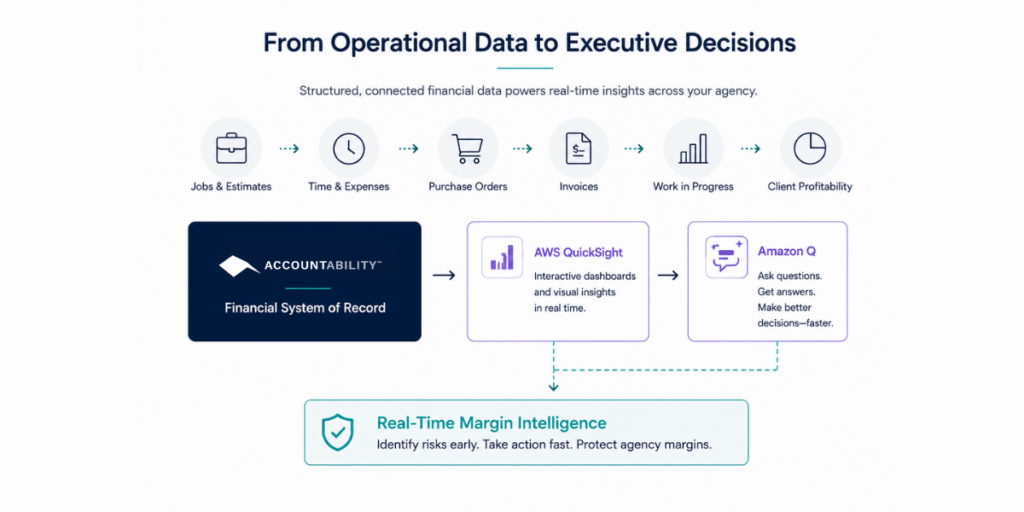
Accountability takes a different approach by acting as the financial system of record for agencies. Every estimate, timesheet, purchase order, expense, approval, invoice, and WIP movement contributes to a live financial model. Built by a former agency CFO, the platform treats operational activity as financial data.
Agency Financial Reporting That Goes Beyond Month-End
Most agencies rely on several systems to run the business. Project managers track delivery. Finance manages accounting. CRM teams monitor opportunities. Resource managers forecast capacity. Each department has valuable information, but none sees the complete financial picture.
Accountability connects those workflows into a single financial system of record built specifically for agencies. Job costing, revenue recognition, forecasting, time and expense management, WIP, client profitability, purchase orders, and multi-entity reporting all work together. Instead of reconciling spreadsheets every month, finance teams can focus on improving profitability.
This also improves decision making across the business. Project managers understand the financial impact of delivery decisions. Account managers see how scope changes affect margins. Executives gain confidence that everyone is working from the same data instead of different reports.
Turn Agency Financial Reporting into Margin Intelligence
Traditional reporting explains what happened.
Modern finance teams need to know what is happening now.
Instead of waiting until month-end, agency leaders should be able to identify projects that are losing money while there is still time to respond. They should know which clients require commercial discussions, which projects have exceeded estimated labour, and where approvals are delaying revenue recognition.
Accountability delivers that visibility because every operational transaction updates the financial picture in real time. Leaders no longer need to investigate declining agency margins after projects finish. They can identify risks while work is still underway and take corrective action before profitability suffers.
Extend Agency Financial Reporting with AWS QuickSight
Good reporting starts with good data.
Because Accountability captures structured financial information across jobs, WIP, forecasting, time, expenses, and client profitability, agencies can extend those insights through AWS QuickSight. Executives gain interactive dashboards that track profitability by client, office, project manager, department, entity, or service line without manually exporting data into spreadsheets.
Instead of building reports every month, finance leaders can monitor trends as they happen. They can quickly identify declining margins, growing WIP balances, changes in utilisation, or projects that need immediate attention. Better visibility leads to faster decisions and stronger financial performance.
Ask Better Questions with Amazon Q
Dashboards help leaders monitor performance.
Amazon Q helps them investigate it.
Because Accountability provides structured financial data, executives can ask business questions using natural language instead of creating custom reports.
For example, a CFO could ask:
- Which five clients lost the most margin this month?
- Which active jobs have exceeded estimated labour?
- Which approvals are delaying revenue recognition?
- Which project managers consistently deliver the highest margins?
Instead of searching through multiple reports, leaders receive immediate answers based on trusted financial data. AI becomes far more valuable because it works from a complete financial dataset rather than disconnected spreadsheets.
Better Agency Financial Reporting Starts with Better Data
Most agencies do not lose profitability because they lack talented people or strong client relationships. They lose profitability because they cannot see small operational issues before those issues become financial problems.
Protecting agency margins starts with visibility. Leaders need to understand how estimates, time, WIP, purchase orders, approvals, forecasting, and client profitability interact throughout every project. When those activities connect inside one platform, agencies move from reacting to financial results to managing profitability every day.
Accountability was built exclusively for agencies to provide that visibility. By combining agency-native financial workflows with structured data, real-time reporting, AWS QuickSight, Amazon Q, and an open API, the platform gives finance and operations one trusted source of truth. Agencies gain the insight they need to protect margins, improve forecasting, and make faster, more informed business decisions.
