


AI financial management for agencies has become one of the most urgent and least solved problems in the industry. When agencies talk about their financial platforms, two frustrations dominate the conversation. The first is generic software, ERPs built for any business, any industry, any workflow. The second is legacy agency platforms, tools that were purpose-built for this industry and once understood the nuances of retainers, utilization, and project margin. Neither is giving agencies what they need right now. But they are failing for very different reasons.
Why AI financial management is failing agencies right now
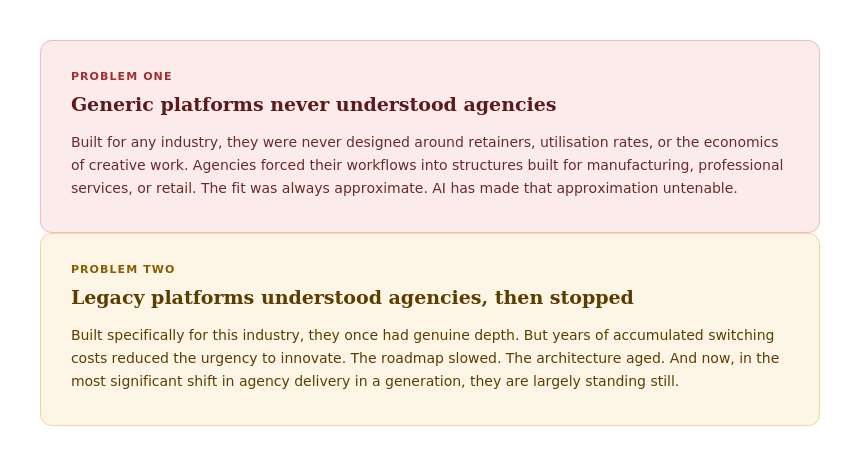
The outcome is the same in both cases: a platform that cannot see AI as a cost, a driver of output, or a variable in margin. One never could. The other chose not to keep up. For agencies living with either, the practical result is identical. Financial data that is structurally blind to how work actually happens today.
The compounding risk
What makes the legacy platform failure particularly sharp is the false sense of security it creates. A generic ERP never claimed to understand agency work deeply. Its limitations are visible, expected, and worked around. But a legacy agency platform carries institutional credibility. Finance teams trust it. Leadership reports from it. It was built for this business, after all. That trust is exactly what makes its blind spots so dangerous.
When a platform that was designed for agencies, that knows what a retainer is, what utilisation means, what a scope change costs, has no concept of AI-assisted delivery, it does not produce obviously wrong answers. It produces plausible ones. Margin reports that look right. Utilisation numbers that feel familiar. Resourcing models that make sense. All of them calculated without accounting for the single biggest change in how the work is done.
A generic platform gives you the wrong answer and you know it is approximate. A legacy agency platform gives you the wrong answer and you believe it. That distinction matters enormously when you are making resourcing, pricing, and investment decisions from that data.
The question is not whether your platform understands your industry. It is whether it understands your industry as it exists right now, where AI is part of every workflow, every cost structure, and every margin calculation.
Your platform should see your whole business. Does it?
If your financial data cannot account for AI, you are not getting the full picture. We work with agencies to close that gap. Not with a sales pitch, but with a real conversation about what accurate, AI-aware financial data looks like in practice.
Talk to our team. Tell us what your platform is missing and we will show you what is possible.
