The Hidden Threat to Agency Margins: Why Small Operational Decisions Become Major Financial Problems
June 30, 2026



Agency Margins Are Under More Pressure Than Ever
For many agencies, revenue continues to grow while profitability moves in the opposite direction. Finance leaders are under pressure to improve performance despite rising labour costs, increasing client expectations, and ongoing economic uncertainty. Research from McKinsey, Deloitte, and the Project Management Institute (PMI) shows that professional services firms must deliver more value with the same resources while maintaining strong financial discipline. For agencies, that creates a difficult challenge. Winning new business is no longer enough. Leaders must also protect agency margins throughout the entire client lifecycle.
Many executives assume declining margins result from one large commercial decision, such as underpricing a major client or losing control of project costs. In reality, agencies usually lose profitability through dozens of small operational decisions that occur every day. A project manager approves another round of revisions. An account manager absorbs additional client requests instead of raising a change order. Team members forget to submit several hours of billable time. Finance waits for purchase approvals before recognising revenue. Each decision feels reasonable in the moment, yet together they steadily reduce profitability.
Traditional financial reports rarely reveal these issues until month-end. By that stage, agency teams have completed the work, suppliers have submitted invoices, and finance has recognised the costs. Leadership can explain why margins declined, but they cannot recover them. Protecting agency margins requires visibility into operational decisions while projects are still active, not weeks after they finish.
Agency Profitability Starts Long Before Month-End
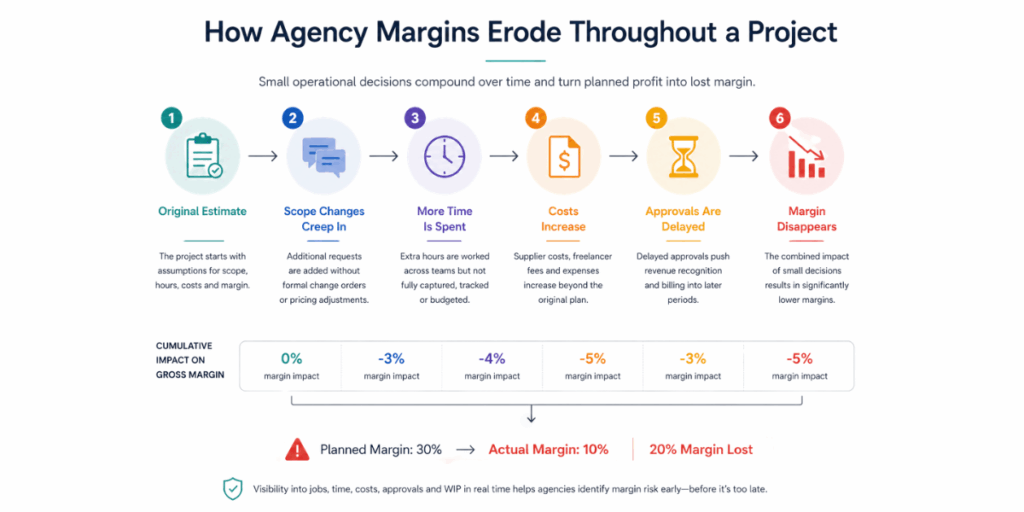
Many organizations treat profitability as a finance metric. Successful agencies understand that profitability begins in operations.
Every client engagement starts with a commercial plan. The estimate defines the expected hours, supplier costs, project timeline, billing milestones, and target margin. From that point forward, every operational decision either protects those assumptions or changes them. Additional labour increases project costs. Delayed approvals push revenue recognition into future reporting periods. Missed timesheets hide the true cost of delivery. Scope changes consume resources that the agency never planned to absorb.
Imagine an integrated campaign that begins with a target gross margin of 40 percent. The estimate includes 200 hours, three client review cycles, and a fixed production budget. During delivery, the client requests another workshop, creative develops two additional concepts, and production extends freelancer contracts because approvals arrive later than expected. Meanwhile, account managers spend extra time coordinating stakeholders but fail to record every hour. None of these decisions appears significant on its own. Together, they fundamentally change the financial outcome of the project.
By the time finance reviews the completed job, the original margin may have fallen from 40 percent to 25 percent. The agency still delivers exceptional work, and the client remains happy, but profitability disappears because the operational reality no longer matches the original estimate. Finance reports the result, yet operations created it.
This is exactly why Accountability was built. Rather than treating estimates, jobs, timesheets, purchase orders, expenses, Work in Progress (WIP), and invoices as separate processes, Accountability connects them into a single financial model designed specifically for agencies. Finance teams no longer wait until month-end to understand profitability because the platform continuously measures the operational activities that create or reduce margin.
Four Small Problems That Quietly Reduce Agency Margins
Scope Creep Starts With Good Intentions
Scope creep rarely begins with a formal contract change. More often, it starts because agency teams want to deliver exceptional client service. An account manager approves another round of revisions. A strategist joins an additional workshop. Creative develops another concept to help secure stakeholder approval. Each decision strengthens the client relationship, but each also increases delivery costs without increasing revenue. Over time, these small decisions reshape the economics of the project, leaving finance to explain why actual profitability no longer matches the original estimate.
Missing Time Hides the True Cost of Delivery
Labour is the largest investment for most agencies, making accurate time capture essential for protecting agency margins. Unfortunately, many teams record time inconsistently. Designers finish work after hours, account managers answer client emails over the weekend, and executives review presentations before major pitches without logging the effort. When those hours never reach the timesheet, project costs appear lower than they really are. Future estimates rely on incomplete historical data, utilisation reports become unreliable, and leadership makes commercial decisions using inaccurate profitability information.
Delayed Approvals Delay Financial Visibility
Approval workflows affect far more than administration. When project managers delay purchase orders, supplier invoices arrive late, or teams postpone expense approvals, finance loses visibility into the true financial position of active jobs. Revenue recognition moves into future reporting periods, Work in Progress continues to grow, and project profitability becomes increasingly difficult to measure accurately. Instead of making decisions using current financial information, agency leaders rely on reports that reflect where the business stood several weeks ago.
Over-Servicing Slowly Becomes the Standard
Many agencies build long-term client relationships by consistently exceeding expectations. While that approach creates stronger partnerships, it also introduces financial risk if additional work becomes routine rather than exceptional. Weekly meetings become twice-weekly meetings. Strategic advice expands beyond the agreed scope. Creative teams continue refining campaigns because they want the best outcome for the client. Although each activity delivers value, few agencies measure its cumulative financial impact. As a result, client satisfaction improves while agency margins gradually decline.
Operational Visibility Protects Margins Before Finance Reports Them
Every agency collects financial data. Far fewer agencies collect the operational data needed to explain profitability.
That distinction matters because project margins change every day, not just at month-end. Estimates evolve, time is recorded, purchase orders are approved, suppliers submit invoices, and projects move through Work in Progress before finance closes the books. When those activities remain disconnected across multiple systems, leaders struggle to understand where margin is leaking until it is too late.
Accountability approaches agency finance differently. The platform serves as the financial system of record by connecting jobs, WIP, time, expenses, forecasting, client profitability, resource planning, and revenue recognition into one structured dataset. That gives finance and operations a shared view of profitability while projects are still in progress rather than after financial results have already been published. It also creates the trusted data foundation agencies need for advanced reporting, automation, and AI-driven decision making.
Continue with Part 2: Why Traditional Financial Systems Can’t Protect Agency Margins
