


The Problem Isn’t the Software. It’s the Fit.
Most agencies did not choose agency finance software built specifically for their operations. Instead, they adopted generic ERP systems that felt safer, more familiar, and widely accepted.
At first, the compromises seemed manageable. A few spreadsheet exports. Some custom fields. Additional workflows outside the system. Reporting layers to bridge operational gaps.
Nothing seemed critical.
However, over time, those compromises compound.
What starts as configuration slowly becomes dependency. Teams adapt their workflows around systems that were never designed for how agencies actually operate.
Eventually, the agency stops working around the system.
Instead, it starts working for the system.
Generic ERP Was Built for Predictability. Agencies Don’t Work That Way.
Traditional ERP platforms were built around stable operational models. Manufacturing. Inventory. Distribution. Fixed cost structures.
Agency operations are fundamentally different.
Revenue shifts constantly. Scope changes mid-project. Time, delivery, and billing rarely move together cleanly. Meanwhile, profitability changes in real time as work happens.
Agencies operate around jobs, retainers, utilization, WIP, estimate-to-actual variance, resource allocation, and constantly evolving delivery models.
Most generic systems do not naturally understand those relationships. As a result, agencies create workaround layers to bridge the gaps.
Over time, those workarounds quietly become part of the business itself.
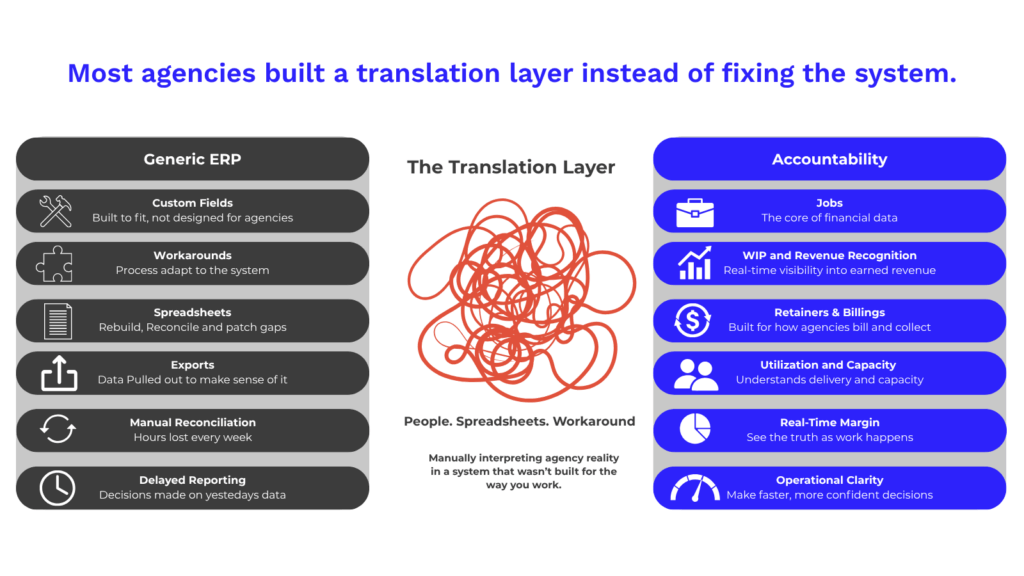
Where Generic ERP Starts Breaking Down
At first, the friction feels operational.
Then it becomes financial.
Finance teams rebuild reports manually, calculate profitability outside the ERP, and spend valuable time reconciling disconnected systems. Meanwhile, operational visibility often arrives too late to influence decisions in real time.
None of this happens because teams are failing.
It happens because the financial structure underneath the business was never designed for agency operations in the first place.
The Hidden Cost of “Making It Work”
One of the biggest problems with generic ERP systems is that they rarely fail dramatically.
Instead, they create slow operational drag.
The organization adapts gradually enough that the friction becomes normalized. Eventually, teams stop questioning why spreadsheets became mission-critical, why reporting takes so long, or why finance and operations operate from different numbers.
That normalization becomes dangerous because slow, manual work starts feeling like business complexity.
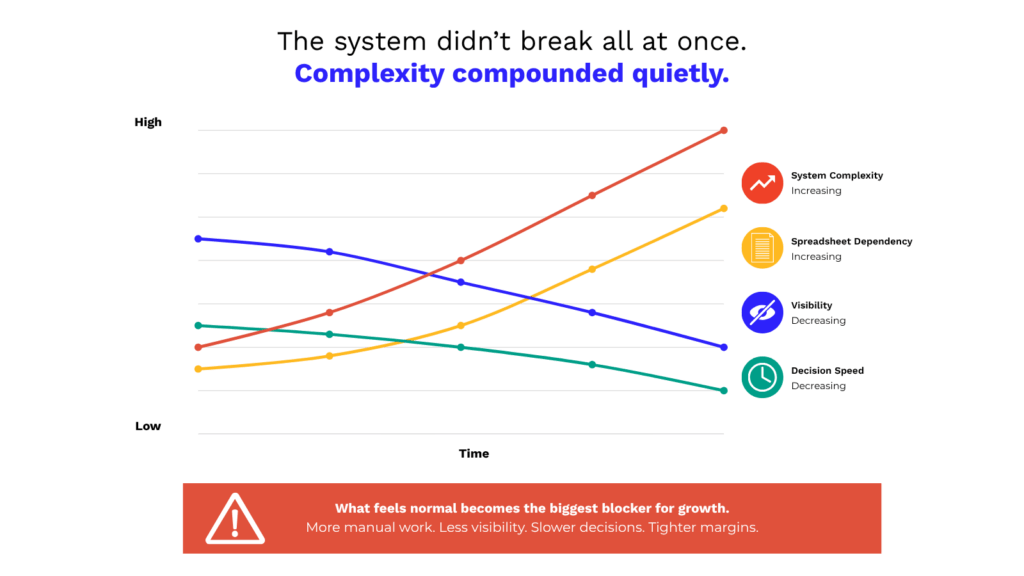
It is not.
It is system misalignment.
As complexity increases, decision-making slows down, margin visibility weakens, and confidence in reporting declines.
The system does not completely fail.
Instead, it slowly limits the agency’s ability to operate with clarity.
Why This Matters More Now
For years, agencies could tolerate these inefficiencies because the market moved slower.
That is no longer true.
Today, agencies are expected to scale faster, protect margins more carefully, operationalize AI, forecast accurately, and make decisions in real time.
Financial latency is becoming a strategic risk. By the time many agencies see the problem in reporting, the margin impact already happened.
The agencies gaining advantage right now are not necessarily the largest.
They are the agencies operating with the clearest financial visibility.
More Dashboards Won’t Solve a Structural Problem
Many agencies respond by adding more dashboards, integrations, and reporting tools.
However, visibility problems rarely come from a lack of reporting.
More often, they come from disconnected financial context.
If the system itself was never structured around agency operations, reporting becomes interpretation instead of truth.
This is also why AI initiatives struggle inside many finance environments.
Tools like Amazon QuickSight and Amazon Q are powerful. However, even the best analytics and AI tools depend entirely on the quality and structure of the underlying data.
Disconnected spreadsheets cannot produce reliable operational insight.
Structured financial data can.
What Modern Agency Finance Software Changes
A modern agency financial management system starts from a different assumption:
The system should reflect how agencies already operate.
Not force agencies to translate themselves into generic business logic.
That changes everything.
Instead of disconnected workflows, jobs become the financial backbone, WIP updates in real time, profitability evolves as work progresses, and finance and operations stay aligned.
Reporting reflects reality without constant reconstruction.
More agencies are moving away from generic ERP tools and toward agency finance software designed specifically for how agencies operate today.
Generic ERP systems did not fail agencies overnight.
Agencies adapted around them slowly enough that the friction became normal.
But the market changed faster than the systems did.
Now, agencies are expected to move in real time while still operating on delayed visibility, disconnected reporting, and workaround-heavy workflows.
The agencies gaining advantage today are not necessarily bigger.
They simply see the business more clearly.
