


Why agency leaders consistently overvalue revenue and undervalue client profitability
Client profitability has become one of the most important metrics in agency management. Yet despite its importance, many agencies still evaluate client relationships primarily through the lens of revenue.
For decades, agency success has been measured by growth. New business wins, revenue expansion, larger retainers, and bigger accounts have become the standard indicators of progress. As agencies scale, leadership teams naturally focus on growing client relationships and increasing top-line revenue.
However, there is a fundamental flaw in relying too heavily on revenue as a measure of success.
Revenue tells you how much business you have won. It does not tell you how much value that business creates.
That distinction has become increasingly important as agencies face rising labor costs, increased client expectations, margin pressure, and growing operational challenges. Consequently, the agencies that outperform their peers are not necessarily the ones generating the most revenue. Instead, they are the ones that understand which client relationships generate the strongest profit.
As agencies continue to face margin pressure, organizations such as the American Association of Advertising Agencies (4A’s) have highlighted the growing need for operational efficiency and profitability.
Unfortunately, many agencies struggle to answer that question with confidence.
The Revenue Illusion and Client Profitability
Most agency leaders can quickly identify their largest clients. However, far fewer can identify their most profitable ones.
The assumption that larger clients automatically create more value is understandable. Large accounts often generate significant revenue, create prestige within the market, and provide a sense of stability. Losing one can feel like a major business risk.
However, revenue alone provides an incomplete picture of client value.
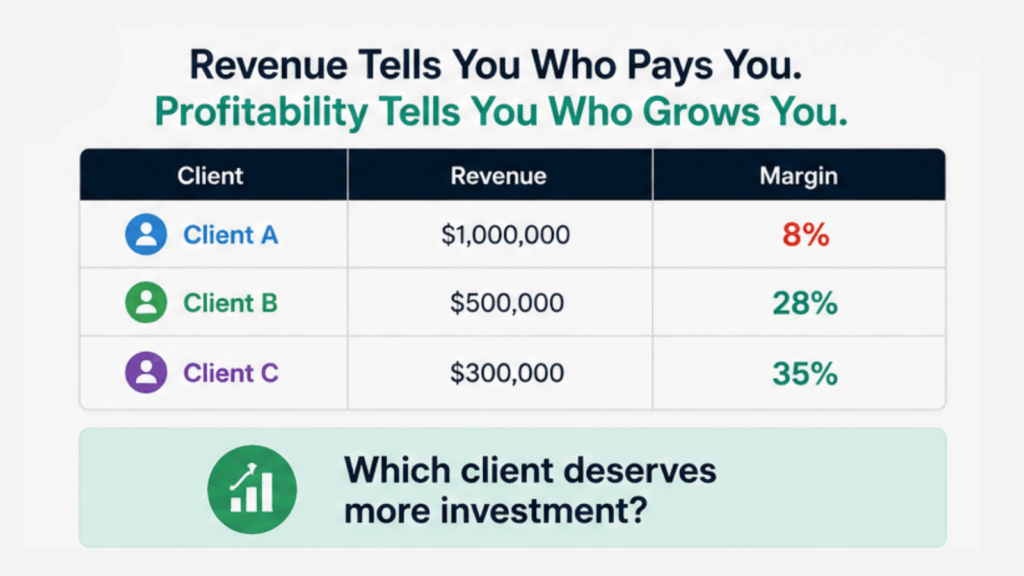
Two clients may generate identical revenue while producing dramatically different financial outcomes. One relationship may operate within scope, require minimal intervention, and generate healthy margins. Another may require constant management attention, frequent revisions, excessive meetings, and substantial amounts of unplanned work.
On a revenue report, they appear equal.
From a client profitability perspective, they could not be more different.
As a result, agencies often make business decisions based on revenue contribution while the true financial impact of the relationship remains largely invisible.
Why Client Profitability Is So Difficult to Measure
Client profitability is one of the most important metrics in agency management, yet it is often one of the most difficult to calculate accurately.
The challenge is that profitability does not exist in a single report.
Instead, it lives at the intersection of jobs, time, expenses, resource planning, billing, revenue recognition, and work-in-progress. Therefore, understanding the complete financial picture requires agencies to connect operational activity with financial outcomes.
In many organizations, this information is fragmented across multiple systems.
- Project teams track delivery in one platform.
- Finance manages reporting in another.
- Time entry sits elsewhere.
- Meanwhile, spreadsheets fill the gaps.
As a result, agencies often operate with a delayed and incomplete understanding of profitability.
By the time financial reports reveal a problem, the work has already been delivered, resources have already been consumed, and the opportunity to adjust course has passed.
Furthermore, this challenge becomes even more pronounced when agencies rely on software that was never designed for agency operations. Without connected financial and operational data, understanding client profitability becomes an exercise in hindsight rather than a tool for decision-making.
The Hidden Cost of High-Revenue Clients
One of the most common findings when agencies begin analyzing client profitability is that some of their largest clients generate surprisingly weak margins.
Importantly, this is rarely the result of a single issue.
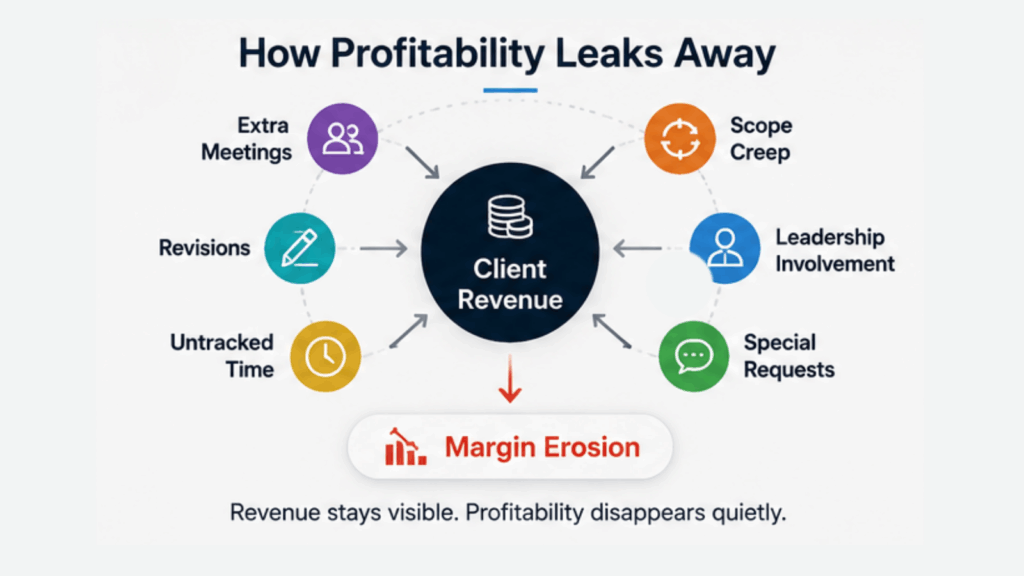
More often, profitability declines gradually through a series of small operational decisions.
- Additional rounds of revisions become standard practice.
- Project scope expands without corresponding budget increases.
- Senior leaders spend increasing amounts of time managing relationships.
- Teams absorb extra work to preserve client satisfaction.
- Special requests become expected rather than exceptional.
Individually, these decisions seem reasonable. Collectively, however, they create a significant financial burden that rarely appears on a revenue report.
Over time, agencies find themselves investing more resources into a client relationship while receiving diminishing financial returns.
Although the client remains important and the relationship remains active, strong revenue can often mask a steady decline in profitability.
Why Agencies Over-Service Their Largest Clients
Many agencies unintentionally create this problem themselves.
High-profile clients often receive preferential treatment. Teams work harder to protect the relationship. Additional requests are accommodated. Scope boundaries become more flexible. Leadership becomes increasingly involved.
While these actions are usually well intentioned, they can distort the economics of the account.
The irony is that agencies often become less disciplined with their largest clients precisely because they fear losing them.
Consequently, the relationship generates substantial revenue while consuming more resources than expected.
Without visibility into client profitability, these trends can continue for years before anyone recognizes the financial impact.
The Agencies Pulling Ahead Are Measuring Value Differently
The strongest agencies are shifting the conversation away from revenue alone and toward financial contribution.
Instead of asking:
“How much revenue does this client generate?”
They ask:
“How profitable is this relationship?”
That shift changes decision-making across the organization.
This perspective influences pricing strategy, improves resource allocation, informs hiring decisions, and creates better conversations around scope management.
Most importantly, it helps leadership understand which client relationships contribute most to long-term growth.
Because not all revenue is equal.
Likewise, not all growth creates value.
Visibility Changes the Conversation
Understanding client profitability requires more than financial reporting.
It requires visibility.
Agency leaders need to understand how jobs are performing, where teams are spending their time, how scope changes impact margins, and which client relationships generate the strongest returns.
At Accountability, we built our platform around this reality.
As the only financial management platform built exclusively for agencies, Accountability connects jobs, time, expenses, billing, work-in-progress, and profitability into a single source of truth. This gives finance and operations leaders the visibility needed to understand client profitability while work is still in progress rather than after the fact.
Rather than relying on assumptions or month-end analysis, leaders can identify trends earlier, understand where profitability is being created, and take action before margins begin to erode.
Ultimately, the goal is not to eliminate difficult clients.
The goal is to understand them.
Because better visibility leads to better decisions.
The Client You Can’t Afford to Keep
Every agency has a client relationship that appears successful on the surface.
- The revenue is strong.
- The relationship is established.
- The account feels important.
Yet beneath the surface, client profitability may tell a very different story.
The agencies that thrive over the next decade will not simply be the ones that acquire more clients. Rather, they will be the ones that understand which relationships create the greatest value.
Revenue will always matter.
However, client profitability ultimately determines whether growth creates momentum or merely creates more work.
And the client you can’t afford to keep may not be the one you think.
Ready to understand which clients are truly driving profitability?
See how Accountability helps agencies connect jobs, time, expenses, billing, and work-in-progress to gain real-time visibility into client profitability and make better financial decisions with confidence.
See which clients are driving profit—and which are quietly eroding it.
