Giving Agencies a Head Start on AI-Powered Financial Intelligence
AI tools seamlessly connected to agency financial data
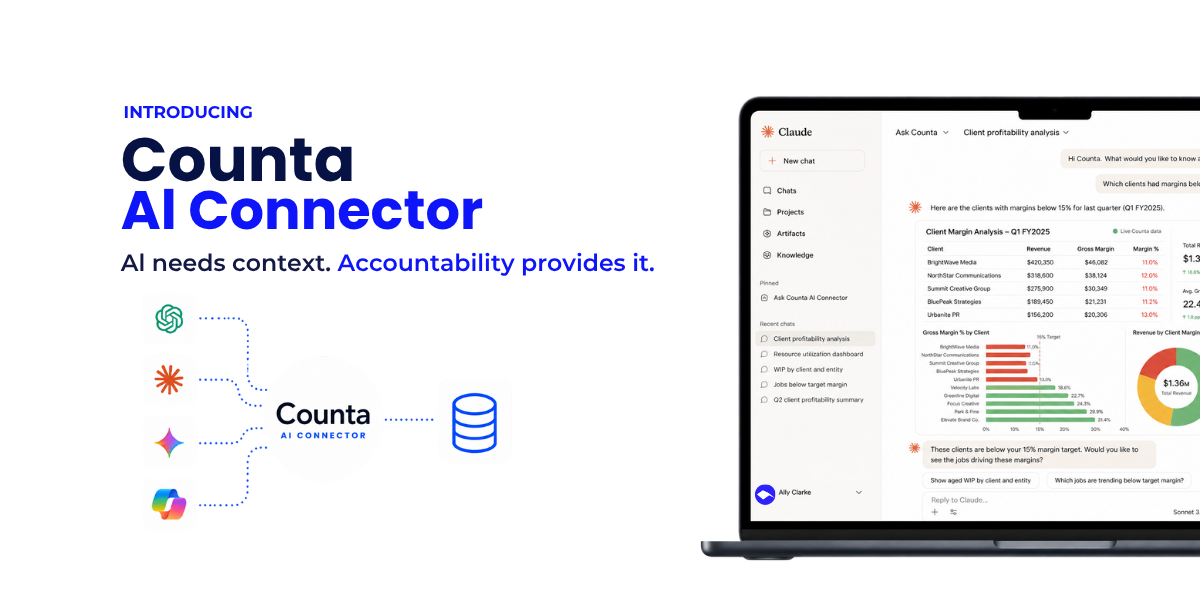
Built on MCP, Counta AI Connector gives AI tools governed access to agency financial data without rebuilding the systems teams rely on.
NEW YORK, NY, UNITED STATES, August 12, 2026 Accountability, the only financial platform built around agency finance, today announced Counta AI Connector, built on the Model Context Protocol (MCP), the open standard for connecting AI tools to business systems.
As agencies adopt AI across finance, operations, and client services, the usefulness of those tools increasingly depends on the data behind them. General-purpose AI can be powerful, but without reliable, agency-specific financial context, it struggles to answer the questions that matter most to agency leaders. Counta AI Connector closes that gap. It connects approved AI assistants, including Claude, ChatGPT, and Gemini, to the agency-focused data structure and reporting logic already managed inside Accountability, letting authorized users ask questions, retrieve live information, and explore financial performance using natural language.
“Accountability is the system of record, MCP is the system of connection, and the AI tools agencies already use are the system of understanding,” said Judd Rubin, CEO of Accountability. “None of those replaces the other. Counta AI Connector lets agencies keep their financial truth in one place while giving their AI tools governed access to it.”
Built for the way agencies operate
Unlike generic ERP platforms that require extensive customization before an AI tool can interpret the data, Accountability was built around the financial and operational realities of agencies from the start. Jobs, work in progress, billing, revenue, resourcing, and client profitability are already connected inside one purpose-built model, supported by reporting logic developed specifically for agency finance. Counta AI Connector extends that structure to approved AI assistants. Instead of forcing AI to reconstruct the business from disconnected spreadsheets or exported reports, the connector gives it access to financial information that’s already organized with the context needed to make it useful, trusted, and actionable; including the same report-ready calculations, like client profitability and aged WIP, that Accountability’s own users rely on.
Governed by design
The AI operates under the connected user’s Accountability permissions. It cannot do what the user cannot do, and every action goes through Accountability’s existing controls. Today, that governed access includes reading financial and operational data, creating and updating time entries, timelines, and daily working times, under the same validations already enforced inside Accountability.
MCP is the system of connection: it gives approved AI tools a standardized way to access Accountability’s governed data and capabilities, alongside the other systems an agency already uses, without requiring a separate integration for every tool.
“We’re not trying to be the AI tool agencies to use,” said Rubin. “We’re the foundation their AI tools connect to. Agencies keep the tools they’ve already picked. Accountability makes sure those tools are working from real numbers instead of guesses.”
About Accountability
Accountability is the only financial platform built around how agencies run finance. It helps creative, media, PR, production, and integrated agencies manage work in progress, project profitability, billing, resource planning, and financial performance from a single platform, structured from the ground up for agency operations.
See what Counta AI Connector makes possible
Connect the AI tools your agency already uses to governed, agency-specific financial data.
Why the next generation of finance requires more than another ERP
Executive Summary
Agency finance is entering a new era.
Artificial intelligence has changed the conversation around finance, but it hasn’t changed the underlying challenge. Finance leaders still depend on the quality of the financial platforms beneath them.
Research from McKinsey suggests that organizations realizing the greatest value from AI first strengthen their data foundations, governance, and operating models before scaling intelligent technologies.
For agencies, that challenge is especially acute. Profitability, work in progress, revenue recognition, and resource management are deeply interconnected. When agencies spread those financial relationships across spreadsheets, disconnected applications, and generic ERP systems, finance loses the visibility needed to make timely commercial decisions..
At Accountability, we’ve long believed agencies deserve a financial platform built around the way they operate—not one adapted from another industry. As finance evolves from reporting historical performance to delivering real-time operational insight, that distinction has become more important than ever.
This article explores why the next generation of agency finance requires more than another ERP. It requires a platform built around agency operations from the start.
The market has outgrown generic financial systems
For many agencies, finance technology has evolved through necessity rather than design. New requirements emerged, new tools were introduced, and additional reporting demands created more customization. Over time, enterprise ERP systems became increasingly complex, while specialist applications filled operational gaps. Finance teams created an ecosystem that required reconciliation across multiple platforms before they could establish a reliable financial position.
That model is becoming increasingly difficult to sustain.
Agency finance now demands continuous visibility rather than periodic reconciliation. Leadership teams expect to understand project profitability before billing is complete, identify margin erosion while projects remain active, and forecast financial performance using live operational data rather than historical assumptions.
These expectations expose the limitations of platforms that treat agency workflows as exceptions rather than core capabilities.
The challenge isn’t that finance teams lack technology. Nearly agencies have invested heavily in it. Instead, those investments have often produced disconnected financial ecosystems. Project management platforms manage delivery. Accounting systems record transactions. Spreadsheets bridge the gaps between them. Finance becomes responsible for reconstructing the relationships that should already exist inside the platform.
As agencies grow, that fragmentation becomes increasingly difficult to manage. Every reconciliation delays decision-making. Spreadsheets introduces another version of the truth. Every disconnected workflow reduces finance’s ability to influence commercial outcomes while work is still in progress.
Building intelligence begins with structure
Artificial intelligence has intensified the conversation around data, but structured financial information has always mattered.
Consider a finance leader asking a seemingly straightforward question:
“Which five clients are most at risk of margin erosion this month, and why?”
Finance leaders cannot find the answer in the general ledger alone.
It requires an understanding of estimates, approved budgets, time captured, supplier commitments, purchase orders, work in progress, billing status, revenue recognition, and historical project performance. More importantly, it requires those relationships to remain intact across the entire financial platform.
This is where many AI discussions become disconnected from operational reality. Organizations often evaluate intelligent capabilities before evaluating the quality of the information those systems will depend upon.
Microsoft’s 2026 Work Trend Index reaches a similar conclusion, highlighting that organizations continue to struggle with fragmented organizational knowledge and disconnected business data, limiting the value AI can deliver.
In practice, intelligence is only as effective as the financial foundation beneath it.
That is why Accountability has always viewed structured financial data as an architectural principle rather than a reporting feature. When agency data is organized consistently around jobs, clients, teams, and financial controls, every capability built on top of it becomes more valuable. Reporting becomes more accurate. Forecasting becomes more reliable. Automation becomes more trustworthy. Artificial intelligence gains the context required to explain, recommend, and eventually act with confidence.
Structured data is not preparation for AI.
It is the prerequisite for modern agency finance.
The financial platform becomes the intelligence layer
Historically, financial systems were designed to record transactions.
Tomorrow’s financial platforms will do considerably more.
They will connect operational activity with financial outcomes, preserving the relationships between project delivery, commercial performance, and accounting. Rather than acting as a passive system of record, the financial platform becomes the intelligence layer that supports every decision across the agency.
This shift changes the role of finance itself.
Instead of spending valuable time exporting reports, reconciling work in progress, and explaining historical performance, finance leaders gain the ability to identify emerging risks while there is still time to influence the outcome. Finance leaders can manage profitability proactively instead of measuring it retrospectively.
At Accountability, we’ve spent years building around a different belief.
We have never viewed agency finance as a collection of disconnected modules. We have always believed agencies deserve one connected financial platform where jobs, time, expenses, billing, approvals, profitability, reporting, and financial controls operate together. The platform doesn’t layer intelligence on afterward.. It is woven into the same operational foundation that agencies already depend upon every day.
This reflects a broader transition occurring across the market. Finance is moving beyond financial management toward financial intelligence—a shift that transforms finance from a reporting function into a strategic capability embedded within agency operations.
A different future for agency finance
The future of agency finance will not be determined by which organization adopts AI first.
Nor will it belong to the agency with the most dashboards or the largest ERP implementation.
It will belong to the agencies that invest in the financial platform beneath every decision.
For years, Accountability has been building toward that future. Long before the market began discussing AI readiness, we focused on agency-native workflows, structured financial data, real-time financial control, and an open architecture capable of supporting whatever comes next. Those decisions were not driven by technology trends. They were driven by a simple conviction that agencies deserve a financial platform built around the way they actually operate.
Today, that conviction has become more relevant than ever.
Agency finance has already entered its next evolution.
Finance leaders are no longer asking whether finance will become more intelligent.
Instead, they’re asking whether the platform beneath it is ready.
Continue the Conversation
The next generation of agency finance demands more than incremental improvements to legacy systems. It requires a financial platform designed around agency operations, structured for intelligence, and built to provide real-time control over profitability, work in progress, and financial performance.
At Accountability, we’ve spent years building for that future. If you’re evaluating how your agency will prepare for the next generation of finance, we’d welcome the opportunity to show you what’s possible.
Why financial platforms must change before AI can deliver
Executive Summary
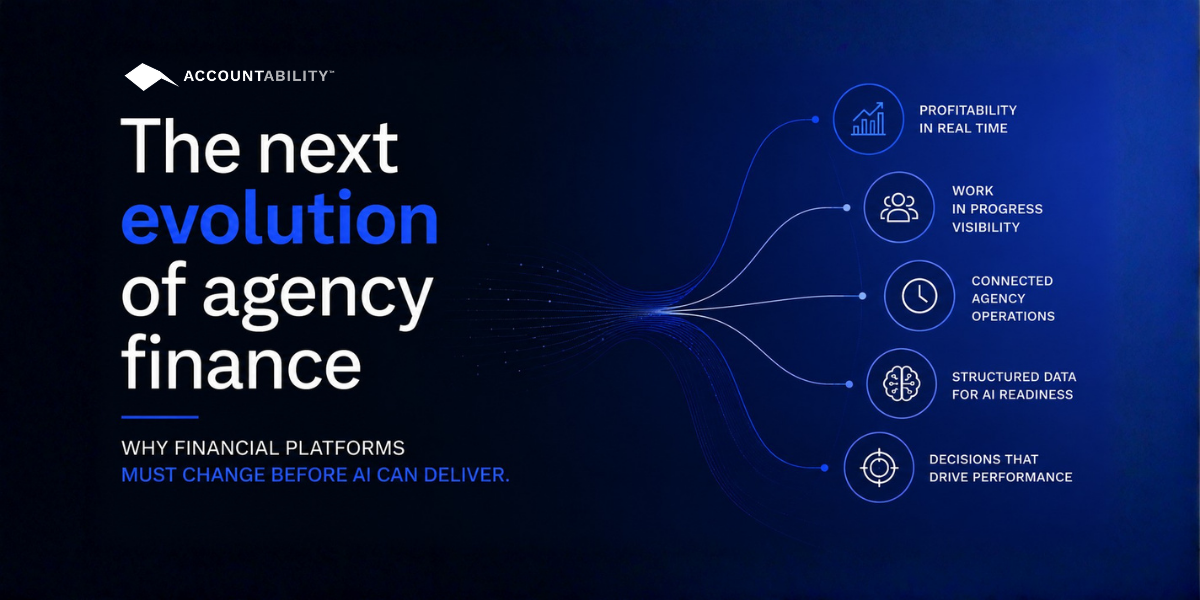
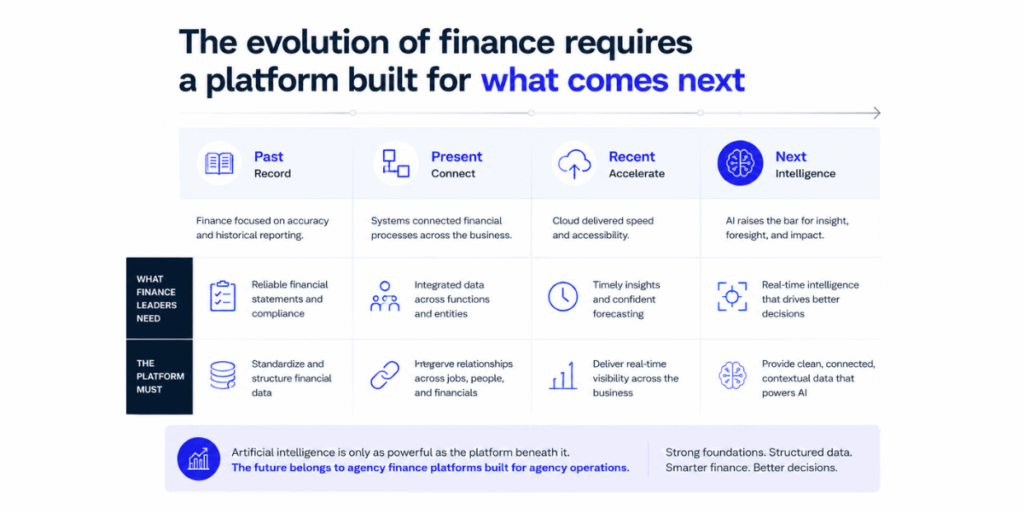
The next evolution of agency finance is already underway. Every significant advance in finance has changed the role of the finance function.
The general ledger standardized accounting. Enterprise Resource Planning (ERP) systems connected financial processes across increasingly complex organizations. Cloud computing made financial information more accessible, reducing the time between transactions and decision-making.
Artificial intelligence is driving the next evolution, but not for the reason many organizations believe.
The conversation has focused almost entirely on what AI can do. The more important question is whether the financial platforms beneath it are capable of supporting the future finance leaders are being asked to deliver.
At Accountability, we’ve spent years building a financial platform around a simple belief: agency finance is fundamentally different from every other industry. Long before AI became the centrepiece of every software roadmap, we believed agencies needed a financial platform built around agency operations, not one adapted from generic ERP software. Today, that belief has become increasingly relevant as finance leaders demand real-time visibility, structured financial data, and operational intelligence that extends far beyond traditional accounting.
The next evolution of agency finance will not be defined by artificial intelligence alone. It will be defined by the financial platforms that make intelligence possible.
The Next Evolution of Agency Finance Has Entered a New Era
For decades, finance was measured by its ability to record the past accurately. The objective was clear: close the books efficiently, produce reliable financial statements, and ensure the organisation met its compliance obligations. Success depended on accuracy, governance, and control.
Those responsibilities remain essential, but they are no longer enough.
Today’s finance leaders are expected to contribute directly to commercial decision-making. Executive teams want finance to explain why profitability is changing before the month closes, identify which client relationships are beginning to erode margin, forecast performance with greater confidence, and provide operational insight while work is still underway. Finance has moved beyond reporting historical performance; it is increasingly expected to influence future performance.
This change is not being driven by artificial intelligence alone. It reflects a broader shift in how organisations compete. Leaders now expect every business function to provide timely, data-driven insight rather than retrospective analysis. Finance sits at the centre of that expectation because every commercial decision ultimately has a financial consequence.
Research reflects this changing landscape.McKinsey has repeatedly found that organizations achieving meaningful returns from AI first invest in strengthening their data foundations, governance, and operating models before scaling AI initiatives rather than treating artificial intelligence as a standalone technology investment.
Microsoft’s 2026 Work Trend Indexreaches a similar conclusion, finding that organizations continue to struggle with fragmented organizational knowledge and disconnected business data, limiting the value AI can deliver despite rapid adoption.
Taken together, these findings point to a broader reality. Artificial intelligence is not replacing the need for better financial platforms. It is increasing it.
Why agencies experience this shift differently
Although every industry is adapting to higher expectations of finance, agencies face a challenge that is fundamentally different from most other organisations.
An agency’s financial performance is inseparable from the work it delivers.
Every client engagement begins with a commercial agreement, but the financial outcome depends on hundreds of operational decisions made throughout the life of the project. Resource allocation, time captured, supplier costs, purchase orders, work in progress, billing schedules, revenue recognition, and profitability continuously influence one another. None of these activities exists in isolation. Their value comes from the relationships between them.
Consider a finance leader reviewing profitability across several major client accounts midway through the month. One project appears profitable because supplier invoices have not yet been received. Another has exceeded budget because consultants have not submitted all of their time. A third has recognised revenue that no longer reflects the actual progress of the work. Viewed independently, each report appears accurate. Viewed together, they tell an incomplete financial story.
This is the challenge that continues to confront many agencies.
Over the past several years, we have spoken with finance leaders who have invested heavily in enterprise ERP implementations, only to discover that finance teams still rely on spreadsheets to reconcile work in progress, project profitability, and revenue recognition. The software was not failing. It was doing exactly what it had been designed to do. The problem was that agency finance had been forced to adapt itself to systems built for industries with fundamentally different operating models.
The result is familiar to almost every agency CFO. Finance spends valuable time reconstructing operational relationships before it can answer relatively simple commercial questions. By the time profitability issues become visible, the opportunity to influence the outcome has often passed.
The Next Evolution of Agency Finance Depends on Better Financial Platforms
Much of today’s discussion assumes that AI will become the defining competitive advantage for finance teams.
We believe that assumption misses a more significant shift.
Artificial intelligence will become increasingly accessible. Every major software platform will embed AI capabilities. Every finance team will have access to intelligent assistants, predictive forecasting, and conversational reporting. Over time, these capabilities will become expected rather than exceptional.
The lasting competitive advantage will not come from the intelligence organisations add. It will come from the quality of the financial platform beneath it.
A financial platform designed around agency operations preserves the relationships that give financial information meaning. Jobs remain connected to time, expenses, purchase orders, work in progress, billing, revenue recognition, and profitability. Financial data is structured consistently because it reflects the way agencies actually operate rather than forcing agency workflows into generic accounting models.
That distinction changes everything.
Real-time visibility becomes possible because finance no longer waits for manual reconciliation. Forecasts become more reliable because operational activity and financial performance remain connected. Artificial intelligence becomes genuinely useful because it understands the commercial context behind every financial event rather than analysing disconnected transactions.
Technology has not changed the purpose of finance.
It has changed the capabilities finance requires from the systems beneath it.
Continue Reading in Part Two
In Part Two, we’ll introduce The Agency Finance Stack, explain why structured financial data has become the foundation of modern finance, and show how Accountability has spent years building the financial platform agencies will need for the next generation of finance.
Continue the Conversation
If your agency is rethinking how it manages profitability, work in progress, forecasting, or financial performance, we’d love to share how Accountability is helping finance leaders prepare for what’s next.
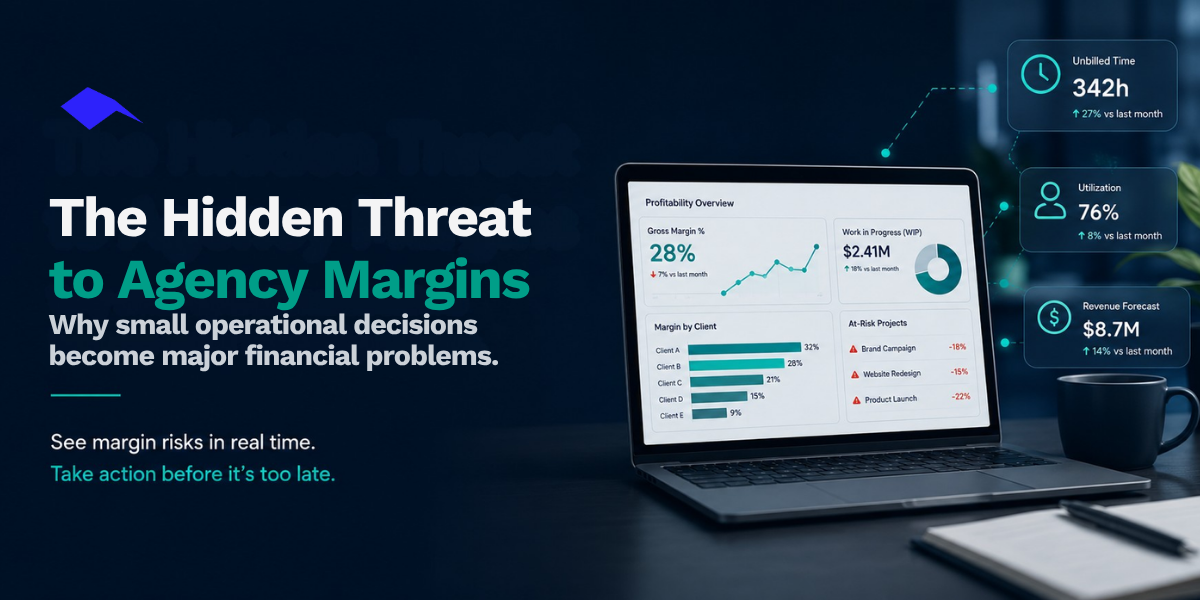
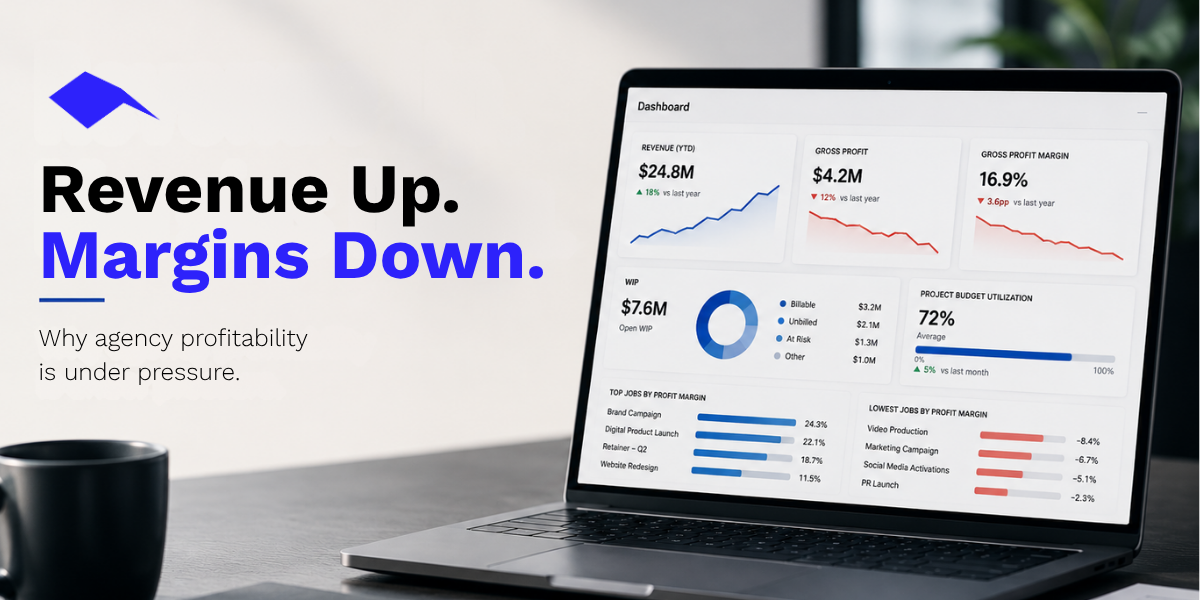
For many agencies, revenue continues to grow while profitability moves in the opposite direction. Finance leaders are under pressure to improve performance despite rising labour costs, increasing client expectations, and ongoing economic uncertainty. Research from McKinsey, Deloitte, and the Project Management Institute (PMI) shows that professional services firms must deliver more value with the same resources while maintaining strong financial discipline. For agencies, that creates a difficult challenge. Winning new business is no longer enough. Leaders must also protect agency margins throughout the entire client lifecycle.
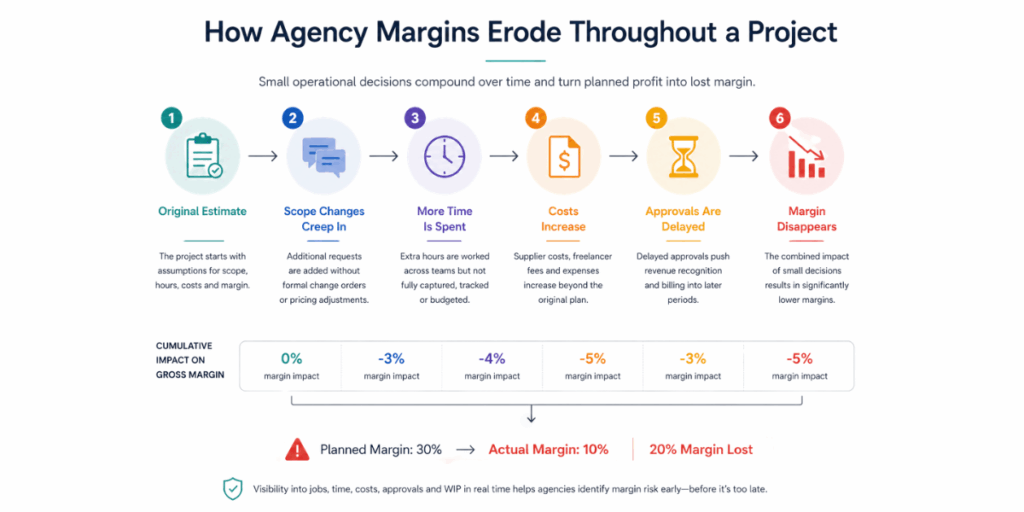
Many executives assume declining margins result from one large commercial decision, such as underpricing a major client or losing control of project costs. In reality, agencies usually lose profitability through dozens of small operational decisions that occur every day. A project manager approves another round of revisions. An account manager absorbs additional client requests instead of raising a change order. Team members forget to submit several hours of billable time. Finance waits for purchase approvals before recognising revenue. Each decision feels reasonable in the moment, yet together they steadily reduce profitability.
Traditional financial reports rarely reveal these issues until month-end. By that stage, agency teams have completed the work, suppliers have submitted invoices, and finance has recognised the costs. Leadership can explain why margins declined, but they cannot recover them. Protecting agency margins requires visibility into operational decisions while projects are still active, not weeks after they finish.
Agency Profitability Starts Long Before Month-End
Many organizations treat profitability as a finance metric. Successful agencies understand that profitability begins in operations.
Every client engagement starts with a commercial plan. The estimate defines the expected hours, supplier costs, project timeline, billing milestones, and target margin. From that point forward, every operational decision either protects those assumptions or changes them. Additional labour increases project costs. Delayed approvals push revenue recognition into future reporting periods. Missed timesheets hide the true cost of delivery. Scope changes consume resources that the agency never planned to absorb.
Imagine an integrated campaign that begins with a target gross margin of 40 percent. The estimate includes 200 hours, three client review cycles, and a fixed production budget. During delivery, the client requests another workshop, creative develops two additional concepts, and production extends freelancer contracts because approvals arrive later than expected. Meanwhile, account managers spend extra time coordinating stakeholders but fail to record every hour. None of these decisions appears significant on its own. Together, they fundamentally change the financial outcome of the project.
By the time finance reviews the completed job, the original margin may have fallen from 40 percent to 25 percent. The agency still delivers exceptional work, and the client remains happy, but profitability disappears because the operational reality no longer matches the original estimate. Finance reports the result, yet operations created it.
This is exactly why Accountability was built. Rather than treating estimates, jobs, timesheets, purchase orders, expenses, Work in Progress (WIP), and invoices as separate processes, Accountability connects them into a single financial model designed specifically for agencies. Finance teams no longer wait until month-end to understand profitability because the platform continuously measures the operational activities that create or reduce margin.
Four Small Problems That Quietly Reduce Agency Margins
Scope Creep Starts With Good Intentions
Scope creep rarely begins with a formal contract change. More often, it starts because agency teams want to deliver exceptional client service. An account manager approves another round of revisions. A strategist joins an additional workshop. Creative develops another concept to help secure stakeholder approval. Each decision strengthens the client relationship, but each also increases delivery costs without increasing revenue. Over time, these small decisions reshape the economics of the project, leaving finance to explain why actual profitability no longer matches the original estimate.
Missing Time Hides the True Cost of Delivery
Labour is the largest investment for most agencies, making accurate time capture essential for protecting agency margins. Unfortunately, many teams record time inconsistently. Designers finish work after hours, account managers answer client emails over the weekend, and executives review presentations before major pitches without logging the effort. When those hours never reach the timesheet, project costs appear lower than they really are. Future estimates rely on incomplete historical data, utilisation reports become unreliable, and leadership makes commercial decisions using inaccurate profitability information.
Delayed Approvals Delay Financial Visibility
Approval workflows affect far more than administration. When project managers delay purchase orders, supplier invoices arrive late, or teams postpone expense approvals, finance loses visibility into the true financial position of active jobs. Revenue recognition moves into future reporting periods, Work in Progress continues to grow, and project profitability becomes increasingly difficult to measure accurately. Instead of making decisions using current financial information, agency leaders rely on reports that reflect where the business stood several weeks ago.
Over-Servicing Slowly Becomes the Standard
Many agencies build long-term client relationships by consistently exceeding expectations. While that approach creates stronger partnerships, it also introduces financial risk if additional work becomes routine rather than exceptional. Weekly meetings become twice-weekly meetings. Strategic advice expands beyond the agreed scope. Creative teams continue refining campaigns because they want the best outcome for the client. Although each activity delivers value, few agencies measure its cumulative financial impact. As a result, client satisfaction improves while agency margins gradually decline.
Operational Visibility Protects Margins Before Finance Reports Them
Every agency collects financial data. Far fewer agencies collect the operational data needed to explain profitability.
That distinction matters because project margins change every day, not just at month-end. Estimates evolve, time is recorded, purchase orders are approved, suppliers submit invoices, and projects move through Work in Progress before finance closes the books. When those activities remain disconnected across multiple systems, leaders struggle to understand where margin is leaking until it is too late.
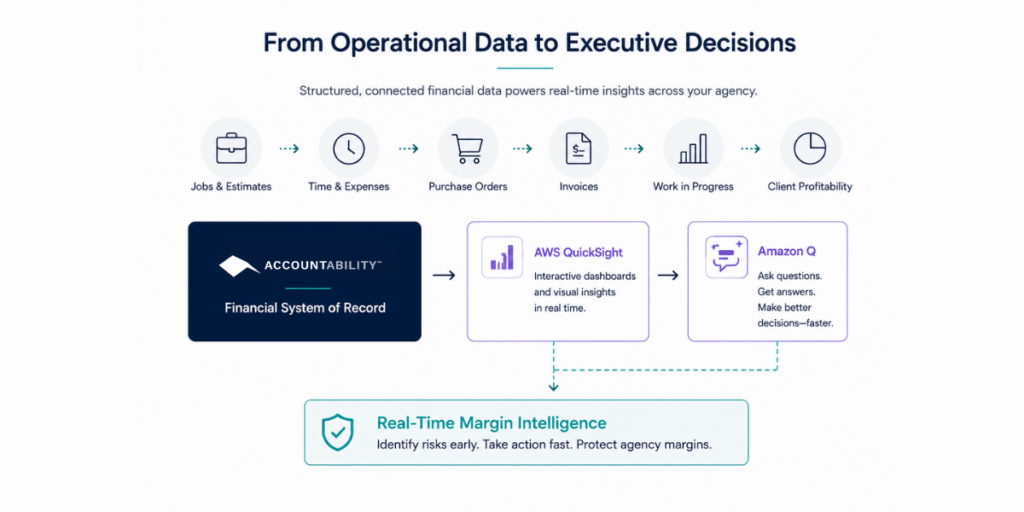
Accountability approaches agency finance differently. The platform serves as the financial system of record by connecting jobs, WIP, time, expenses, forecasting, client profitability, resource planning, and revenue recognition into one structured dataset. That gives finance and operations a shared view of profitability while projects are still in progress rather than after financial results have already been published. It also creates the trusted data foundation agencies need for advanced reporting, automation, and AI-driven decision making.
Agency financial reporting should do more than produce month-end statements. It should connect operational and financial data so agency leaders can understand profitability as work happens, not weeks later. Traditional ERP platforms were designed to close the books, but they rarely provide the visibility finance teams need to identify margin risk while projects are still in progress.
Agency leaders need answers to different questions. Which jobs are running over budget? Which clients regularly exceed their approved scope? Where are delayed approvals increasing Work in Progress (WIP)? Which teams are failing to submit time? Traditional accounting software cannot answer these questions because it focuses on the general ledger instead of the job.
Accountability takes a different approach by acting as the financial system of record for agencies. Every estimate, timesheet, purchase order, expense, approval, invoice, and WIP movement contributes to a live financial model. Built by a former agency CFO, the platform treats operational activity as financial data.
Agency Financial Reporting That Goes Beyond Month-End
Most agencies rely on several systems to run the business. Project managers track delivery. Finance manages accounting. CRM teams monitor opportunities. Resource managers forecast capacity. Each department has valuable information, but none sees the complete financial picture.
Accountability connects those workflows into a single financial system of record built specifically for agencies. Job costing, revenue recognition, forecasting, time and expense management, WIP, client profitability, purchase orders, and multi-entity reporting all work together. Instead of reconciling spreadsheets every month, finance teams can focus on improving profitability.
This also improves decision making across the business. Project managers understand the financial impact of delivery decisions. Account managers see how scope changes affect margins. Executives gain confidence that everyone is working from the same data instead of different reports.
Turn Agency Financial Reporting into Margin Intelligence
Traditional reporting explains what happened.
Modern finance teams need to know what is happening now.
Instead of waiting until month-end, agency leaders should be able to identify projects that are losing money while there is still time to respond. They should know which clients require commercial discussions, which projects have exceeded estimated labour, and where approvals are delaying revenue recognition.
Accountability delivers that visibility because every operational transaction updates the financial picture in real time. Leaders no longer need to investigate declining agency margins after projects finish. They can identify risks while work is still underway and take corrective action before profitability suffers.
Extend Agency Financial Reporting with AWS QuickSight
Good reporting starts with good data.
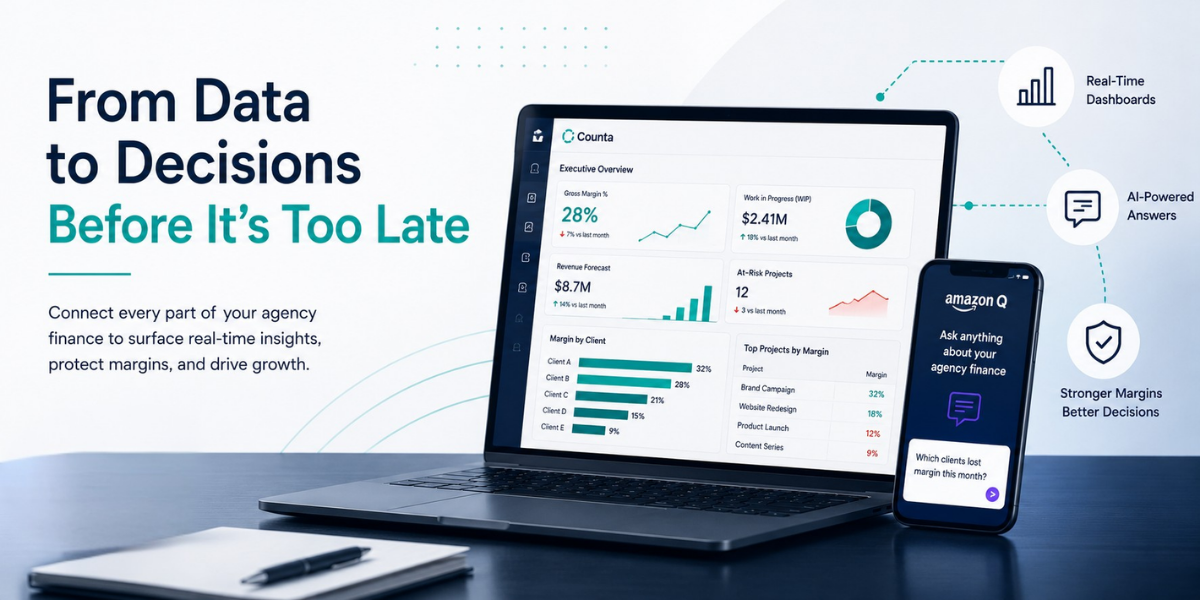
Because Accountability captures structured financial information across jobs, WIP, forecasting, time, expenses, and client profitability, agencies can extend those insights through AWS QuickSight. Executives gain interactive dashboards that track profitability by client, office, project manager, department, entity, or service line without manually exporting data into spreadsheets.
Instead of building reports every month, finance leaders can monitor trends as they happen. They can quickly identify declining margins, growing WIP balances, changes in utilisation, or projects that need immediate attention. Better visibility leads to faster decisions and stronger financial performance.
Because Accountability provides structured financial data, executives can ask business questions using natural language instead of creating custom reports.
For example, a CFO could ask:
Which five clients lost the most margin this month?
Which active jobs have exceeded estimated labour?
Which approvals are delaying revenue recognition?
Which project managers consistently deliver the highest margins?
Instead of searching through multiple reports, leaders receive immediate answers based on trusted financial data. AI becomes far more valuable because it works from a complete financial dataset rather than disconnected spreadsheets.
Better Agency Financial Reporting Starts with Better Data
Most agencies do not lose profitability because they lack talented people or strong client relationships. They lose profitability because they cannot see small operational issues before those issues become financial problems.
Protecting agency margins starts with visibility. Leaders need to understand how estimates, time, WIP, purchase orders, approvals, forecasting, and client profitability interact throughout every project. When those activities connect inside one platform, agencies move from reacting to financial results to managing profitability every day.
Accountability was built exclusively for agencies to provide that visibility. By combining agency-native financial workflows with structured data, real-time reporting, AWS QuickSight, Amazon Q, and an open API, the platform gives finance and operations one trusted source of truth. Agencies gain the insight they need to protect margins, improve forecasting, and make faster, more informed business decisions.
Why structured financial data is the real competitive advantage for modern agencies.
When the world’s best football teams walk onto the pitch, the hard work is already behind them. Weeks before kickoff, coaches study performance data, analyze opponents, and refine every tactical decision. Modern agencies face a similar challenge. Artificial intelligence is creating new opportunities, but success depends on one critical advantage: structured financial data. Without it, even the most advanced AI cannot deliver reliable business insights.
Businesses are entering a similar era.
Artificial intelligence is changing the way leaders make decisions, uncover insights, and improve performance. According to McKinsey’s State of AI report, 78% of organizations now use AI in at least one business function, nearly doubling adoption in just a few years. At the same time, Microsoft’s 2024 Work Trend Index found that 75% of knowledge workers already use AI at work, while business leaders increasingly expect AI to improve productivity and support faster decision-making.
For agencies, those expectations create both opportunity and pressure.
AI promises faster reporting, better forecasting, smarter resource planning, and deeper profitability insights. However, many agencies are discovering that AI doesn’t solve poor financial data. Instead, it exposes it.
That is why the conversation shouldn’t begin with artificial intelligence.
It should begin with your financial foundation.
Why Structured Financial Data Matters for AI
AI has generated plenty of excitement, but it has also created unrealistic expectations.
Many organizations assume they can layer AI on top of existing systems and immediately gain better answers. Unfortunately, technology doesn’t work that way.
AI can’t determine which profitability report is correct if different systems produce different numbers. Likewise, it can’t understand how work in progress relates to billing if those records live in separate applications. It also can’t identify margin risk when project data, time tracking, and financial reporting tell different stories.
Instead, AI reflects the quality of the information it receives.
When financial data is accurate, connected, and structured, AI produces meaningful insights. When financial information is inconsistent or incomplete, AI simply delivers faster versions of the same uncertainty.
Research from Deloitte’s State of AI in the Enterprise continues to identify data quality, integration, and governance as three of the biggest barriers preventing organizations from scaling AI successfully. Simply put, businesses don’t have an AI problem. Many have a data problem.
Why Agencies Face a Bigger Challenge
Every business manages financial transactions.
Agencies manage financial relationships.
A manufacturing company measures inventory and production. A retailer tracks products and sales. Agencies operate differently. Every project creates a network of connected financial activities that changes every day.
Employees submit time.
Project managers update budgets.
Finance approves purchase orders.
Freelancers submit invoices.
Work in progress increases.
Revenue is recognized.
Profitability shifts.
None of these activities happens in isolation. Together, they tell the financial story of every client engagement.
As a result, agency finance depends on context rather than individual transactions. When information becomes disconnected across spreadsheets, project management tools, accounting systems, and reporting platforms, leaders lose confidence in the numbers that guide important business decisions.
Consequently, finance teams spend more time collecting information than analyzing it.
Winning Starts with Structured Financial Data
Every successful football manager understands one simple truth.
Preparation creates confidence.
The same principle applies to AI.
Organizations that rush into AI without first building structured financial data often discover that automation accelerates existing problems instead of solving them.
Disconnected systems become easier to spot.
Reporting differences become harder to explain.
Manual work becomes more obvious.
Meanwhile, finance teams continue spending valuable time validating reports rather than advising the business.
By contrast, agencies with connected financial data gain something far more valuable than automation.
They gain confidence.
Leadership can trust forecasts.
Finance can explain profitability.
Operations can make faster decisions.
AI becomes a business advantage because it is working with reliable information instead of trying to interpret incomplete data.
AI Needs Context, Not Just Numbers
Imagine asking AI a straightforward question.
“Which clients are becoming less profitable?”
Although the question sounds simple, the answer requires much more than a revenue report.
AI must understand how much time has been spent on each job, how work in progress has changed, whether project budgets remain on track, which expenses have been incurred, how resources have been allocated, and whether revenue has been recognized correctly.
Without those relationships, AI can only summarize information.
With structured financial data, AI begins to provide meaningful recommendations.
For example, it can help answer questions like:
Which clients are putting margins at risk?
Which projects require immediate attention?
Which teams have available capacity?
Where is forecast revenue beginning to decline?
Which accounts should leadership review before month-end?
Those are not simply reporting questions.
They are business decisions that influence growth, profitability, and long-term performance.
Structured Financial Data Is the Competitive Advantage
For years, agencies selected financial software based on features.
Could it manage billing?
Could it support multiple entities?
Could it produce financial reports?
Today, the conversation has changed.
Agency leaders still expect those capabilities, but they also need connected data that supports automation, forecasting, and AI.
According to PwC’s Global AI Survey, organizations are increasingly realizing that trusted, well-managed data is one of the strongest predictors of successful AI adoption. In other words, AI doesn’t create competitive advantage on its own. Better data does.
That shift is particularly important for agencies.
As clients demand greater transparency, margins become tighter, and leadership expects faster decisions, the quality of financial information becomes just as important as the reports themselves.
Why Accountability Starts with Structured Financial Data
At Accountability, we’ve always believed agencies deserve technology built specifically for the way they work.
Rather than adapting a generic ERP to support agency workflows, we built our platform around them. Jobs, work in progress, billing, profitability, forecasting, revenue recognition, and operational controls work together as one connected financial system. That means agencies spend less time reconciling data and more time making informed decisions.
More importantly, structured financial data creates the foundation that modern AI depends on. Instead of asking AI to interpret disconnected information, agencies can give it a complete financial picture that delivers more reliable insights.
Today’s agencies don’t need another AI tool.
They need a stronger financial foundation.
Get AI Ready
Every great football team begins with a playbook.
Every successful AI strategy begins with structured financial data.
The agencies that gain the greatest advantage from AI won’t simply adopt the latest technology. They’ll build the financial foundation that allows AI to deliver meaningful, trusted, and actionable insights.That level of confidence only comes from structured financial data that connects every financial event across the agency.
At Accountability, that’s exactly what we’ve been building from day one.
When customers think about a successful software implementation, they often focus on the end result.
The platform is live. Reporting is running smoothly. Teams have adopted new processes. Leadership has better visibility into the business.
What customers don’t always see is the work that happens behind the scenes to make that outcome possible.
At Accountability, people like Bhakti Tigdi play an important role in turning plans into results.
As a Project Manager based in New Jersey, Bhakti helps lead strategic initiatives and customer programs across the business. Her role requires balancing priorities, coordinating teams, managing timelines, and helping customers navigate change. It is a position that demands both structure and adaptability.
Bringing Order to Complexity
Project management is often misunderstood.
Many people associate it with schedules, status updates, and task lists. While those things are important, the real challenge is helping people move toward a common goal while managing competing priorities along the way.
That challenge is particularly relevant in software implementations. Every customer has different processes, expectations, and business objectives. Success depends on understanding those differences and creating a path forward that works for everyone involved.
Bhakti enjoys that balance between planning and problem-solving. No two projects are exactly alike, which means every engagement brings an opportunity to learn something new.
Growth Happens Outside Your Comfort Zone
Outside of work, Bhakti recently returned to a hobby she loved as a child: dancing.
After stepping away from it for several years, she decided to reconnect with something that had always brought her joy. The experience reminded her that growth often comes from revisiting old passions and challenging yourself in new ways.
That same mindset influences how she approaches her work.
The best project managers understand that learning never stops. New challenges, new customers, and new situations require curiosity, flexibility, and a willingness to keep improving.
When she’s not working or dancing, Bhakti enjoys listening to music and settling in for a good horror movie.
The People Behind the Platform
One of the reasons Bhakti enjoys working at Accountability is the opportunity to work alongside people who genuinely want to see one another succeed.
Technology companies often talk about innovation, but great teams are built on something much simpler: trust, collaboration, and a shared commitment to helping customers achieve their goals.
Those qualities show up every day in the way Bhakti approaches her work.
Friends describe her as caring, hardworking, and emotionally intelligent. They see her as someone people can depend on when it matters most. Those same qualities help her build strong relationships with customers and colleagues alike.
As Accountability continues to grow, we remain committed to building a company where talented people can do meaningful work, support one another, and continue developing their skills.
Bhakti is a great example of that culture in action.
She’s not just helping manage projects.
She’s helping create successful outcomes for the agencies that trust Accountability to power their business.
Stay tuned for the next installment of Meet the People Behind Accountability as we continue introducing the people who make our company what it is.
New clients, larger accounts, more employees, and higher revenue all signal progress. Yet many agencies discover that growth alone does not create a stronger business. In fact, growth often creates new challenges that can put pressure on profitability.
The agencies that achieve profitable agency growth over the long term do more than increase revenue. They build the visibility, processes, and financial discipline needed to support profitable agency growth.
Research from Harvard Business Review has consistently shown that sustainable growth depends on an organization’s ability to turn revenue gains into long-term value. For agencies, that means understanding not only how much revenue they generate, but also how efficiently they deliver it.
Growth Creates Complexity
Growth tends to expose weaknesses that were largely invisible when the business was smaller. Processes that once felt efficient become increasingly reliant on manual work, disconnected systems, and institutional knowledge. As complexity increases, leadership teams often spend more time gathering information and less time acting on it.
Every new client adds more than revenue. It adds projects, staffing requirements, billing arrangements, reporting expectations, and profitability targets. New service lines create additional planning challenges. More employees require stronger forecasting and resource management.
Over time, many agencies find themselves asking questions that should be easy to answer:
Which clients generate the highest margins?
Which projects need attention right now?
Do we have enough capacity to support future growth?
Are we hiring because demand requires it or because visibility is limited?
Without reliable answers, growth becomes harder to manage.
Why Margins Often Shrink as Revenue Grows
Many agencies assume that higher revenue will naturally lead to higher profits.
In practice, the opposite often happens.
Margin erosion usually comes from small issues that build over time. Scope creep expands project requirements. Utilization drops. Teams spend more time on low-margin work. Hiring decisions happen before leaders fully understand future demand. Delayed reporting makes it difficult to identify problems early.
None of these challenges are unusual. The real problem is that many agencies cannot see them quickly enough.
According to research from McKinsey & Company, companies that outperform their peers combine growth with operational discipline. They understand where revenue comes from, how profit is generated, and what actions improve performance over time.
For agencies, that requires visibility beyond top-line revenue.
Financial Visibility Is Now a Competitive Advantage
Agency leaders once treated reporting as a finance responsibility. Today, it plays a much larger role in business strategy.
Hiring plans, pricing decisions, client investments, and growth initiatives all depend on accurate financial information. Yet many agencies still rely on disconnected tools and spreadsheet-driven reporting processes.
Finance teams often pull data from accounting systems, project management platforms, time-tracking tools, and spreadsheets just to build a complete picture of the business. By the time leaders review the information, the opportunity to influence the outcome may already be gone.
Real-time visibility changes that dynamic.
When leaders can see profitability, work-in-progress, resource forecasts, and utilization as work happens, they can make better decisions faster. They can identify risks before they affect margins and allocate resources with greater confidence.
This becomes even more important as agencies adopt automation and AI. As Deloitte Insights notes, organizations need reliable and structured data before they can take full advantage of emerging technologies.
Building a Foundation for Profitable Agency Growth
The agencies that scale successfully tend to invest in systems built for the way agencies operate.
Generic ERP systems support many industries, but agencies run on different metrics. Jobs, work-in-progress, utilization, resource planning, and project profitability drive agency performance. When financial systems do not reflect those realities, teams often fill the gaps with manual processes and spreadsheets.
Accountability was built specifically for agencies to solve this challenge. Founded by a former agency CFO, the platform gives agency leaders real-time visibility into WIP, job profitability, resource forecasts, billing activity, and overall financial performance. It also supports multi-entity and multi-currency operations while connecting to the broader agency technology stack through open APIs.
Better reporting is only the starting point. Agencies need a financial foundation that helps them understand performance as it happens, forecast future demand, and make confident decisions as they grow. Accountability was designed to provide exactly that.
Growth Should Increase Value, Not Complexity
Winning new business is only part of the equation.
The agencies that lead the next decade will not win because they are the biggest. They will win because they understand their numbers, protect their margins, and make decisions faster than their competitors.
Profitable agency growth requires visibility, forecasting, and financial clarity. It requires leaders to understand not only what happened last month, but what is happening right now and what is likely to happen next.
Revenue growth increases the size of an agency.
Profitable growth increases its value.
The difference often comes down to having the right financial foundation in place before complexity outpaces visibility.
Why agency leaders consistently overvalue revenue and undervalue client profitability
Client profitability has become one of the most important metrics in agency management. Yet despite its importance, many agencies still evaluate client relationships primarily through the lens of revenue.
For decades, agency success has been measured by growth. New business wins, revenue expansion, larger retainers, and bigger accounts have become the standard indicators of progress. As agencies scale, leadership teams naturally focus on growing client relationships and increasing top-line revenue.
However, there is a fundamental flaw in relying too heavily on revenue as a measure of success.
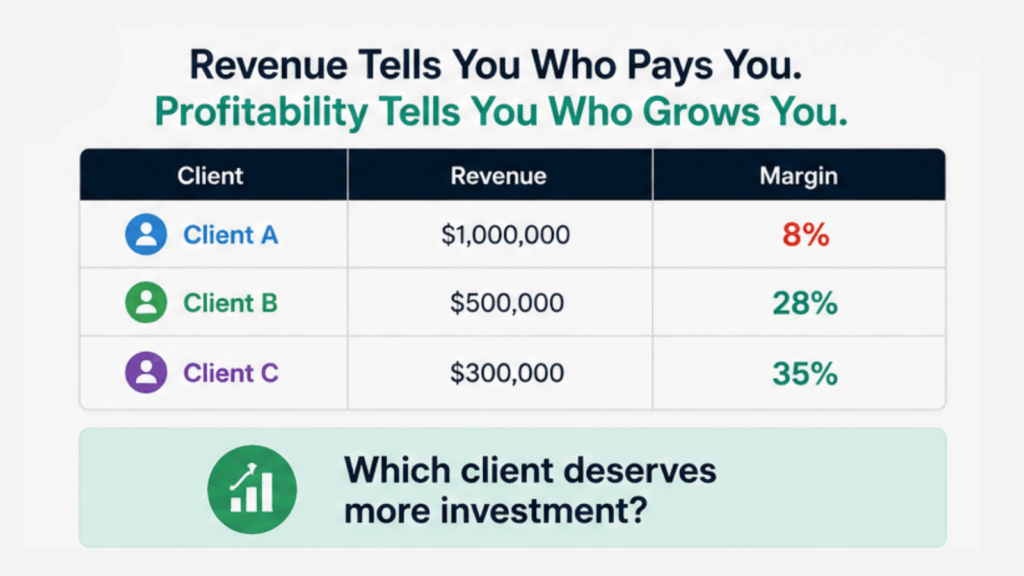
Revenue tells you how much business you have won. It does not tell you how much value that business creates.
That distinction has become increasingly important as agencies face rising labor costs, increased client expectations, margin pressure, and growing operational challenges. Consequently, the agencies that outperform their peers are not necessarily the ones generating the most revenue. Instead, they are the ones that understand which client relationships generate the strongest profit.
Unfortunately, many agencies struggle to answer that question with confidence.
The Revenue Illusion and Client Profitability
Most agency leaders can quickly identify their largest clients. However, far fewer can identify their most profitable ones.
The assumption that larger clients automatically create more value is understandable. Large accounts often generate significant revenue, create prestige within the market, and provide a sense of stability. Losing one can feel like a major business risk.
However, revenue alone provides an incomplete picture of client value.
Two clients may generate identical revenue while producing dramatically different financial outcomes. One relationship may operate within scope, require minimal intervention, and generate healthy margins. Another may require constant management attention, frequent revisions, excessive meetings, and substantial amounts of unplanned work.
On a revenue report, they appear equal.
From a client profitability perspective, they could not be more different.
As a result, agencies often make business decisions based on revenue contribution while the true financial impact of the relationship remains largely invisible.
Why Client Profitability Is So Difficult to Measure
Client profitability is one of the most important metrics in agency management, yet it is often one of the most difficult to calculate accurately.
The challenge is that profitability does not exist in a single report.
Instead, it lives at the intersection of jobs, time, expenses, resource planning, billing, revenue recognition, and work-in-progress. Therefore, understanding the complete financial picture requires agencies to connect operational activity with financial outcomes.
In many organizations, this information is fragmented across multiple systems.
Project teams track delivery in one platform.
Finance manages reporting in another.
Time entry sits elsewhere.
Meanwhile, spreadsheets fill the gaps.
As a result, agencies often operate with a delayed and incomplete understanding of profitability.
By the time financial reports reveal a problem, the work has already been delivered, resources have already been consumed, and the opportunity to adjust course has passed.
Furthermore, this challenge becomes even more pronounced when agencies rely on software that was never designed for agency operations. Without connected financial and operational data, understanding client profitability becomes an exercise in hindsight rather than a tool for decision-making.
The Hidden Cost of High-Revenue Clients
One of the most common findings when agencies begin analyzing client profitability is that some of their largest clients generate surprisingly weak margins.
Importantly, this is rarely the result of a single issue.
More often, profitability declines gradually through a series of small operational decisions.
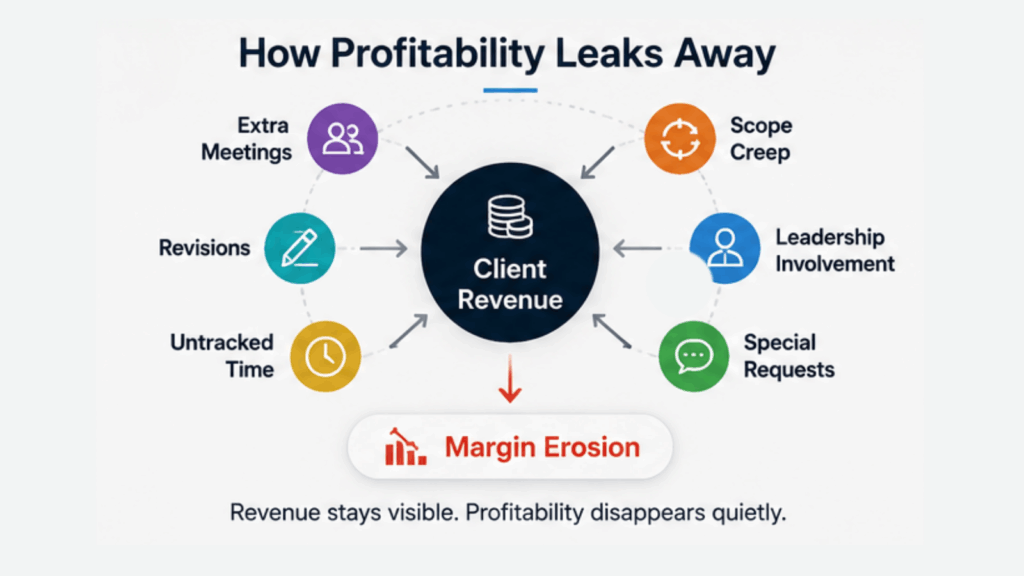
Additional rounds of revisions become standard practice.
Project scope expands without corresponding budget increases.
Senior leaders spend increasing amounts of time managing relationships.
Teams absorb extra work to preserve client satisfaction.
Special requests become expected rather than exceptional.
Individually, these decisions seem reasonable. Collectively, however, they create a significant financial burden that rarely appears on a revenue report.
Over time, agencies find themselves investing more resources into a client relationship while receiving diminishing financial returns.
Although the client remains important and the relationship remains active, strong revenue can often mask a steady decline in profitability.
Why Agencies Over-Service Their Largest Clients
Many agencies unintentionally create this problem themselves.
High-profile clients often receive preferential treatment. Teams work harder to protect the relationship. Additional requests are accommodated. Scope boundaries become more flexible. Leadership becomes increasingly involved.
While these actions are usually well intentioned, they can distort the economics of the account.
The irony is that agencies often become less disciplined with their largest clients precisely because they fear losing them.
Consequently, the relationship generates substantial revenue while consuming more resources than expected.
Without visibility into client profitability, these trends can continue for years before anyone recognizes the financial impact.
The Agencies Pulling Ahead Are Measuring Value Differently
The strongest agencies are shifting the conversation away from revenue alone and toward financial contribution.
Instead of asking:
“How much revenue does this client generate?”
They ask:
“How profitable is this relationship?”
That shift changes decision-making across the organization.
This perspective influences pricing strategy, improves resource allocation, informs hiring decisions, and creates better conversations around scope management.
Most importantly, it helps leadership understand which client relationships contribute most to long-term growth.
Because not all revenue is equal.
Likewise, not all growth creates value.
Visibility Changes the Conversation
Understanding client profitability requires more than financial reporting.
It requires visibility.
Agency leaders need to understand how jobs are performing, where teams are spending their time, how scope changes impact margins, and which client relationships generate the strongest returns.
At Accountability, we built our platform around this reality.
As the only financial management platform built exclusively for agencies, Accountability connects jobs, time, expenses, billing, work-in-progress, and profitability into a single source of truth. This gives finance and operations leaders the visibility needed to understand client profitability while work is still in progress rather than after the fact.
Rather than relying on assumptions or month-end analysis, leaders can identify trends earlier, understand where profitability is being created, and take action before margins begin to erode.
Ultimately, the goal is not to eliminate difficult clients.
The goal is to understand them.
Because better visibility leads to better decisions.
The Client You Can’t Afford to Keep
Every agency has a client relationship that appears successful on the surface.
The revenue is strong.
The relationship is established.
The account feels important.
Yet beneath the surface, client profitability may tell a very different story.
The agencies that thrive over the next decade will not simply be the ones that acquire more clients. Rather, they will be the ones that understand which relationships create the greatest value.
Revenue will always matter.
However, client profitability ultimately determines whether growth creates momentum or merely creates more work.
And the client you can’t afford to keep may not be the one you think.
Ready to understand which clients are truly driving profitability?
See how Accountability helps agencies connect jobs, time, expenses, billing, and work-in-progress to gain real-time visibility into client profitability and make better financial decisions with confidence.
Why agency profitability is under pressure and what the most successful agencies are doing about it
On paper, many agencies are having a good year. Revenue is growing, new clients are coming in, teams are busy, and pipelines remain healthy. Yet despite those positive indicators, a growing number of agency leaders are asking the same question:
Why does it feel like we’re working harder than ever for less return?
At Accountability, we speak with agency CFOs, Controllers, COOs, and agency leaders every day about one critical challenge: improving agency profitability in an increasingly complex business environment.
Revenue may be increasing, but margins remain under pressure. Teams are busier, yet leadership often feels less confident about the financial health of the business. Agencies are balancing rising costs, increasing client expectations, and a level of complexity that many of their systems were never designed to support.
The issue is not a lack of demand. Many agencies are winning new business and delivering exceptional work. The challenge is understanding whether that growth is actually creating value.
Revenue growth and profit growth are not the same thing.
For many agencies, the gap between the two continues to widen.
Why Agency Profitability Is Under Pressure
Agency leaders face pressure from every direction. Clients expect more value and faster turnaround times while labor costs, technology investments, and overhead continue to rise. Agencies deliver more work than ever before, often under pricing models that have not kept pace with the cost of delivering that work.
This creates a serious problem. Revenue can continue to grow while agency profitability slowly declines. From the outside, the business appears healthy. Behind the scenes, margins begin to erode project by project and client by client.
Most agencies do not lose profitability because of a single major mistake. Margin erosion happens gradually through hundreds of small decisions that often go unnoticed until the financial impact becomes impossible to ignore.
Rising labor costs, increasing client expectations, and economic uncertainty are forcing agencies to look more closely at profitability than ever before. Industry research from the Association of National Advertisers (ANA) (https://www.ana.net) shows that marketers continue to demand greater efficiency and accountability from agency partners.
Where Agency Profitability Actually Disappears
Many leaders assume profitability challenges start in the finance department. In reality, they begin much earlier.
A project exceeds its original scope. A team spends extra time satisfying a client request. Hours go unrecorded. A retainer remains unchanged despite increased demands. Individually, these situations seem manageable. Together, they create a significant gap between the work an agency planned to deliver and the work it actually delivers.
Scope creep rarely arrives as a major event. More often, it appears as a series of reasonable decisions made in the moment. An additional meeting. Another round of revisions. A few extra hours to strengthen a client relationship.
Over time, those decisions add up.
Agency leaders often discover the impact only after the project is complete and the month has closed. By then, they have already lost the opportunity to course-correct.
Busy Doesn’t Mean Profitable
One of the most dangerous assumptions in agency management is that a busy agency is automatically a profitable agency.
Some of the busiest agencies are quietly sacrificing margin because they lack visibility into where time, resources, and effort are actually being spent. Growth can hide inefficiency. Revenue can hide margin erosion. Utilization can hide over-servicing.
From a distance, the numbers may look strong. A closer look often reveals a different story.
This is why many agency leaders feel frustrated when they review annual results. Revenue increased, new clients were added, and teams stayed busy. Yet profitability failed to improve at the same pace.
The real question is not whether your agency is growing.
The real question is whether your agency is growing profitably.
How Real-Time Visibility Improves Agency Profitability
The agencies protecting margins most effectively are not necessarily working harder than everyone else. They are simply seeing problems sooner.
Rather than waiting for month-end reports, these agencies monitor the activities that directly affect profitability. They know when projects consume more hours than expected, and recognize when clients begin pushing beyond scope. They identify resource challenges before they become financial problems.
At Accountability, this is why we built our agency financial management platform around the way agencies actually operate.
Agency profitability does not begin in the general ledger. It begins with jobs, people, time, expenses, billing, and client work. When that information lives in disconnected systems, finance teams spend their time looking backward. When those activities are connected, leaders gain the visibility needed to make decisions in real time.
The difference is significant.
Instead of discovering a profitability issue after the work is complete, agencies can identify risk while projects are still active. Instead of relying on historical reports, they gain visibility into the day-to-day activities that affect profitability.
The goal is not better reporting.
The goal is better decisions.
What High-Performing Agencies Do Differently
The most successful agencies ask different questions.
Instead of focusing solely on revenue, they seek to understand what is driving profitability across the business.
They ask:
Which clients generate the strongest margins?
Which projects consistently exceed budget?
Where are we over-servicing?
Which services create the most value?
How much work are we giving away?
Agency leaders need answers to these questions while there is still time to act, not after the month has ended.
High-performing agencies create alignment between finance, operations, account management, and leadership. They understand where teams spend their time, identify budget risks early, and trust the numbers because everyone is working from the same source of truth.
That level of visibility allows leaders to solve problems before they impact profitability.
The Future Belongs to Agencies That Protect Margin
The next decade will not be defined by who grows the fastest.
It will be defined by who grows the smartest.
Revenue will always matter. New business will always matter. However, the agencies that thrive will understand exactly how their business makes money and where profit is being created.
The strongest organizations recognize margin risk early, understand which clients and projects generate the greatest value, and act quickly when performance begins to drift. Instead of reacting to historical reports, they use real-time visibility to make informed decisions while there is still time to influence the outcome.
Success will come from clarity, not complexity.
At Accountability, we believe agency finance should help leaders make better decisions, not simply produce reports. When jobs, time, expenses, billing, and profitability live in one place, agencies gain the visibility needed to protect margins, improve performance, and grow with confidence.
Revenue is important.
Profitability creates the freedom to invest, innovate, hire great people, and build a stronger business.
Protecting it has never mattered more.
Ready to understand where your margins are really going?
See how Accountability helps agencies gain real-time visibility into profitability, eliminate reporting delays, and make smarter financial decisions before margins are impacted.