Approving vs posting may sound like a technical accounting distinction, but for agencies, the difference directly affects financial control, WIP, profitability, and reporting.
Approval confirms that a transaction should happen. Posting confirms that it is ready to become part of the agency’s financial records.
That distinction matters because agency finance rarely follows a simple transaction-to-ledger path. Timesheets affect WIP. Expenses need to reach the right job and client. Supplier invoices may require project or department approval. Client billing can affect revenue recognition and profitability reporting.
When approval and posting are treated as the same step, finance teams can lose an important layer of control between operational activity and the financial statements.
What is approval in accounting?
Approval is the business decision that a transaction is accurate, authorized, and appropriate.
Consider a $12,000 production invoice related to a client campaign.
Before finance records that cost, someone may need to confirm:
- The work was actually performed.
- The amount agrees with the estimate or purchase authorization.
- The expense belongs to the correct client and job.
- The agency should absorb the cost or rebill it to the client.
- The transaction complies with the agency’s approval policies.
That is approval.
The person making that decision does not necessarily need responsibility for the agency’s general ledger. Their job is to confirm the business context behind the transaction.
What does posting mean?
Posting is the financial step.
Once a transaction has passed the required approvals, finance determines whether it is ready to be recorded in the accounting system.
Posting makes the transaction part of the agency’s financial records and allows it to flow into the reporting processes that finance depends on.
The simplest distinction is:
Approval asks: Should we accept this transaction?
Posting asks: Is this transaction ready to affect our financial records?
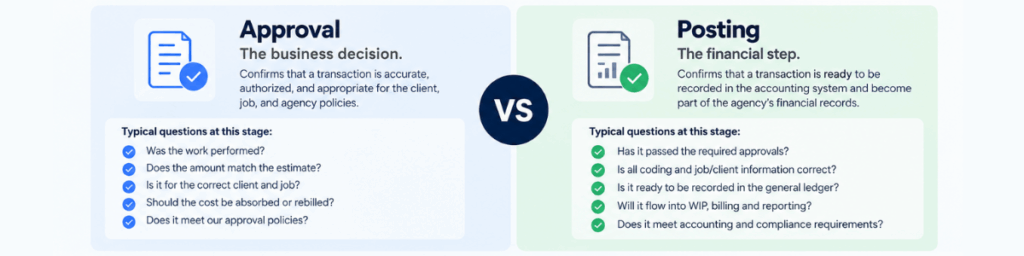
Separating those questions creates an important control point.
Why Approving vs Posting Matters for Agencies
Agency finance is unusually dependent on operational data.
A single client engagement can involve employee time, freelance costs, media, production expenses, purchase orders, supplier invoices, client billing, WIP, and revenue recognition.
Those transactions do not necessarily arrive in the order finance would prefer.
Imagine that a creative team incurs a $15,000 production cost against a client job. The project lead knows whether the work was authorized. Finance knows how the cost should be treated in the accounting records.
Those are different responsibilities.
A strong financial workflow allows the project lead to approve the business transaction while preserving finance’s control over when and how it is posted.
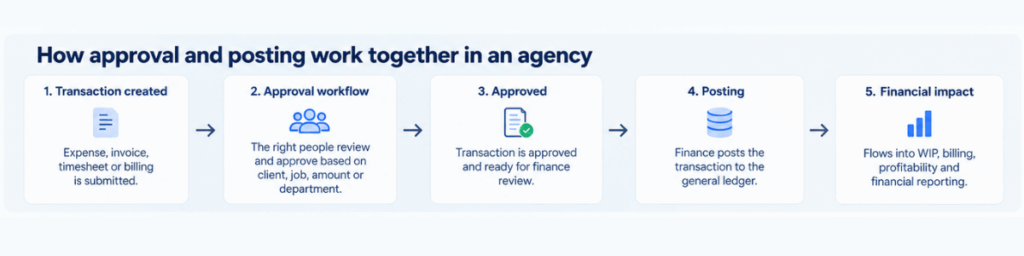
Approval is also about routing the right decision to the right person
As agencies grow, a single approval rule becomes increasingly difficult to manage.
A $75 employee expense should not necessarily follow the same approval path as a $75,000 production invoice.
Different transactions may require approval based on:
- Employee or department
- Client
- Job
- Transaction type
- Dollar threshold
- Manager
- Office or entity
This is where financial workflow design becomes important.
The objective is not to add approvals everywhere. It is to put the appropriate control at the point where someone has enough context to make the decision.
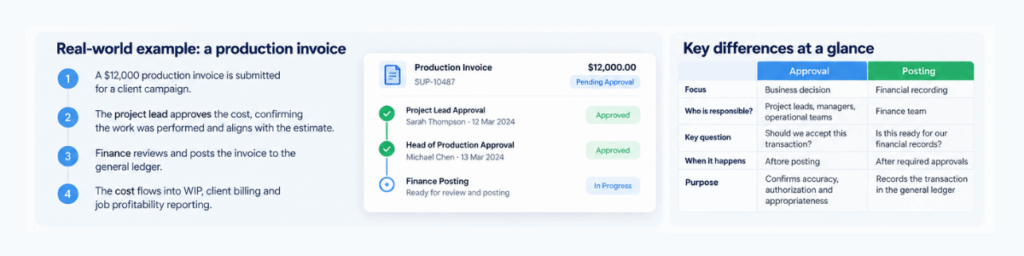
The cost of getting the workflow wrong
Poorly designed approval processes usually create one of two problems.
Too little control: Transactions reach the financial records before the right people have reviewed them. Finance then spends time investigating, correcting, or reversing activity.
Too much control: Every transaction follows the same approval chain, creating bottlenecks that delay expenses, billing, WIP, and month-end reporting.
The goal is therefore not simply “more approvals.”
It is a workflow that balances control, speed, and accountability.
What a good agency approval and posting process should provide
Agency finance leaders evaluating their current process should ask:
- Can approval authority vary by transaction type, value, job, client, or employee?
- Can multiple or sequential approvals be required when appropriate?
- Can finance clearly see which transactions are approved but not yet posted?
- Is there a reliable record of who approved a transaction?
- Can operational managers approve activity without giving them unnecessary accounting access?
- Do approved transactions flow cleanly into WIP, billing, job profitability, and financial reporting?
If answering those questions requires spreadsheets, email chains, or manual reconciliation, the problem may be larger than the approval process itself.
How Counta approaches agency financial workflows
Counta is built specifically around the financial workflows of agencies.
Rather than forcing agency operations into the structure of a generic ERP, the platform connects jobs, clients, time, expenses, WIP, billing, revenue, and financial reporting within the same financial system of record.
That includes configurable approval workflows. For expense claims, for example, agencies can use approval scenarios to determine required approvals based on the transaction and can establish sequential approval paths when more than one review is required.
Once the required approvals are complete, the transaction can move to finance for review and posting.
The result is a clearer separation between the people responsible for authorizing agency activity and the finance team responsible for protecting the integrity of the financial records.
See how agency-native financial workflows work
If your finance team is spending too much time chasing approvals, reconciling transactions, or determining what is ready to post, the underlying issue may be the system connecting agency operations to finance.
See how Counta gives agency finance teams control over jobs, WIP, expenses, billing, profitability, and financial reporting in one platform.