Categories
Blog

Why Generic ERP Is Becoming a Competitive Disadvantage for Agencies

The Problem Isn’t the Software. It’s the Fit.

Most agencies did not choose agency finance software built specifically for their operations. Instead, they adopted generic ERP systems that felt safer, more familiar, and widely accepted.

At first, the compromises seemed manageable. A few spreadsheet exports. Some custom fields. Additional workflows outside the system. Reporting layers to bridge operational gaps.

Nothing seemed critical.

However, over time, those compromises compound.

What starts as configuration slowly becomes dependency. Teams adapt their workflows around systems that were never designed for how agencies actually operate.

Eventually, the agency stops working around the system.

Instead, it starts working for the system.

Generic ERP Was Built for Predictability. Agencies Don’t Work That Way.

Traditional ERP platforms were built around stable operational models. Manufacturing. Inventory. Distribution. Fixed cost structures.

Agency operations are fundamentally different.

Revenue shifts constantly. Scope changes mid-project. Time, delivery, and billing rarely move together cleanly. Meanwhile, profitability changes in real time as work happens.

Agencies operate around jobs, retainers, utilization, WIP, estimate-to-actual variance, resource allocation, and constantly evolving delivery models.

Most generic systems do not naturally understand those relationships. As a result, agencies create workaround layers to bridge the gaps.

Over time, those workarounds quietly become part of the business itself.
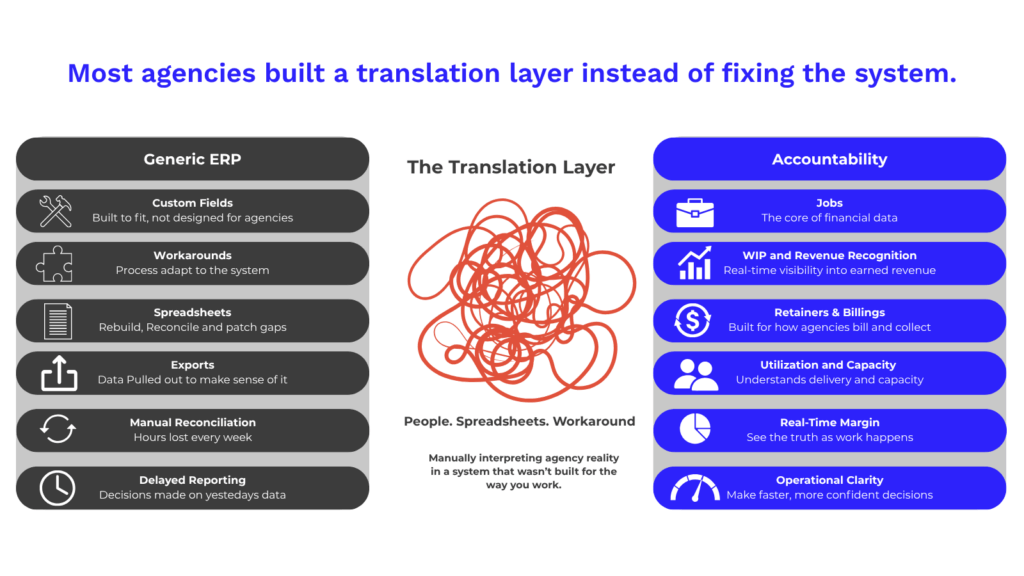
Where Generic ERP Starts Breaking Down

At first, the friction feels operational.

Then it becomes financial.

Finance teams rebuild reports manually, calculate profitability outside the ERP, and spend valuable time reconciling disconnected systems. Meanwhile, operational visibility often arrives too late to influence decisions in real time.

None of this happens because teams are failing.

It happens because the financial structure underneath the business was never designed for agency operations in the first place.

The Hidden Cost of “Making It Work”

One of the biggest problems with generic ERP systems is that they rarely fail dramatically.

Instead, they create slow operational drag.

The organization adapts gradually enough that the friction becomes normalized. Eventually, teams stop questioning why spreadsheets became mission-critical, why reporting takes so long, or why finance and operations operate from different numbers.

That normalization becomes dangerous because slow, manual work starts feeling like business complexity.
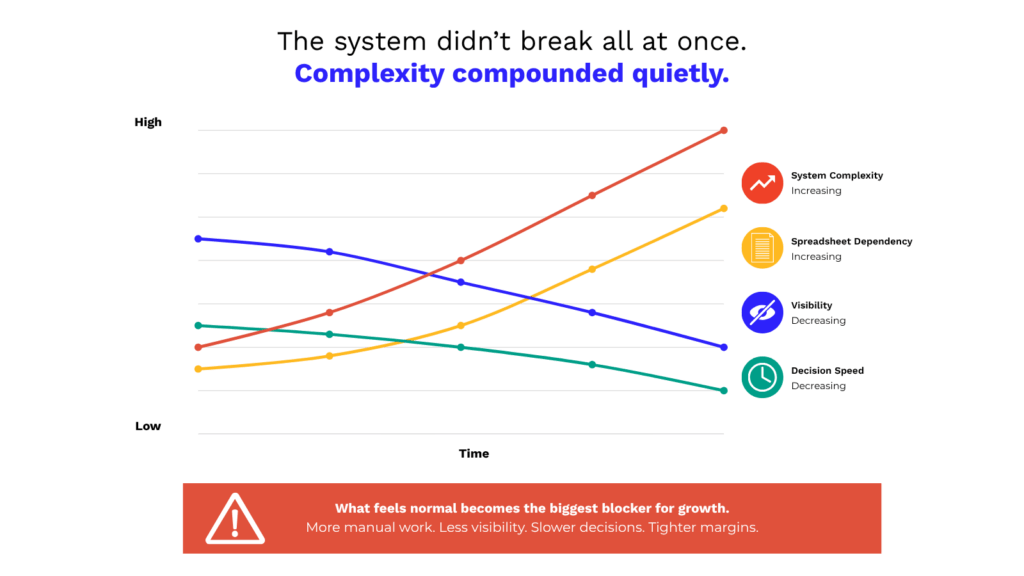
It is not.

It is system misalignment.

As complexity increases, decision-making slows down, margin visibility weakens, and confidence in reporting declines.

The system does not completely fail.

Instead, it slowly limits the agency’s ability to operate with clarity.

Why This Matters More Now

For years, agencies could tolerate these inefficiencies because the market moved slower.

That is no longer true.

Today, agencies are expected to scale faster, protect margins more carefully, operationalize AI, forecast accurately, and make decisions in real time.

Financial latency is becoming a strategic risk. By the time many agencies see the problem in reporting, the margin impact already happened.

The agencies gaining advantage right now are not necessarily the largest.

They are the agencies operating with the clearest financial visibility.

More Dashboards Won’t Solve a Structural Problem

Many agencies respond by adding more dashboards, integrations, and reporting tools.

However, visibility problems rarely come from a lack of reporting.

More often, they come from disconnected financial context.

If the system itself was never structured around agency operations, reporting becomes interpretation instead of truth.

This is also why AI initiatives struggle inside many finance environments.

Tools like Amazon QuickSight and Amazon Q are powerful. However, even the best analytics and AI tools depend entirely on the quality and structure of the underlying data.

Disconnected spreadsheets cannot produce reliable operational insight.

Structured financial data can.

What Modern Agency Finance Software Changes

A modern agency financial management system starts from a different assumption:

The system should reflect how agencies already operate.

Not force agencies to translate themselves into generic business logic.

That changes everything.

Instead of disconnected workflows, jobs become the financial backbone, WIP updates in real time, profitability evolves as work progresses, and finance and operations stay aligned.

Reporting reflects reality without constant reconstruction.

More agencies are moving away from generic ERP tools and toward agency finance software designed specifically for how agencies operate today.

Generic ERP systems did not fail agencies overnight.

Agencies adapted around them slowly enough that the friction became normal.

But the market changed faster than the systems did.

Now, agencies are expected to move in real time while still operating on delayed visibility, disconnected reporting, and workaround-heavy workflows.

The agencies gaining advantage today are not necessarily bigger.

They simply see the business more clearly.

Categories
Blog

Two roads to the same dead end

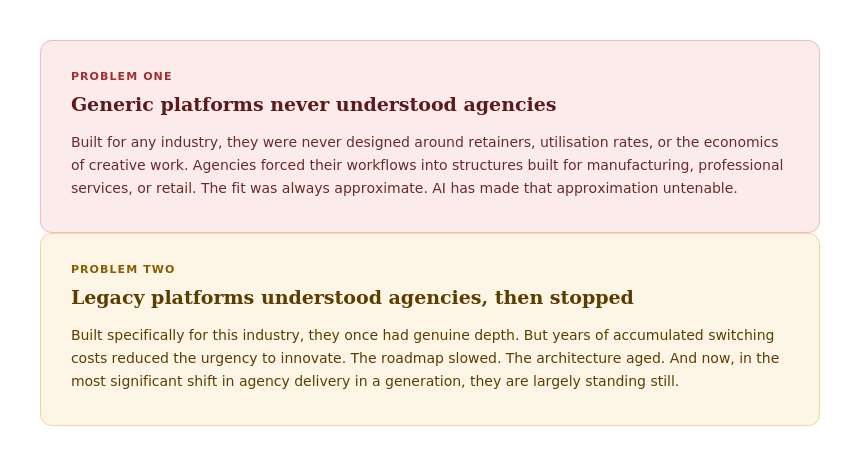
AI financial management for agencies has become one of the most urgent and least solved problems in the industry. When agencies talk about their financial platforms, two frustrations dominate the conversation. The first is generic software, ERPs built for any business, any industry, any workflow. The second is legacy agency platforms, tools that were purpose-built for this industry and once understood the nuances of retainers, utilization, and project margin. Neither is giving agencies what they need right now. But they are failing for very different reasons.

Why AI financial management is failing agencies right now

The outcome is the same in both cases: a platform that cannot see AI as a cost, a driver of output, or a variable in margin. One never could. The other chose not to keep up. For agencies living with either, the practical result is identical. Financial data that is structurally blind to how work actually happens today.

The compounding risk

What makes the legacy platform failure particularly sharp is the false sense of security it creates. A generic ERP never claimed to understand agency work deeply. Its limitations are visible, expected, and worked around. But a legacy agency platform carries institutional credibility. Finance teams trust it. Leadership reports from it. It was built for this business, after all. That trust is exactly what makes its blind spots so dangerous.

When a platform that was designed for agencies, that knows what a retainer is, what utilisation means, what a scope change costs, has no concept of AI-assisted delivery, it does not produce obviously wrong answers. It produces plausible ones. Margin reports that look right. Utilisation numbers that feel familiar. Resourcing models that make sense. All of them calculated without accounting for the single biggest change in how the work is done.

A generic platform gives you the wrong answer and you know it is approximate. A legacy agency platform gives you the wrong answer and you believe it. That distinction matters enormously when you are making resourcing, pricing, and investment decisions from that data.

The question is not whether your platform understands your industry. It is whether it understands your industry as it exists right now, where AI is part of every workflow, every cost structure, and every margin calculation.

Your platform should see your whole business. Does it?

If your financial data cannot account for AI, you are not getting the full picture. We work with agencies to close that gap. Not with a sales pitch, but with a real conversation about what accurate, AI-aware financial data looks like in practice.

Talk to our team. Tell us what your platform is missing and we will show you what is possible.

Categories
News

AI-Powered Agency Financial Reporting: Accountability Launches QuickSight

New QuickSight add-on delivers AI-powered agency financial reporting — letting teams ask questions about their data in plain English and get instant answers.


New York, NY — Accountability, the agency-native ERP and financial management platform, today announced the launch of QuickSight. This new add-on brings AI-powered agency financial reporting directly into the Accountability platform. Finance teams can now ask questions about their data in plain English. They get instant answers. No spreadsheets. No waiting on reports.

The feature is powered by QuickSight Q, a natural language query tool. Instead of building reports manually, users simply ask. For example: “What was our most profitable client in Q3?” or “Which jobs are running over budget?” Answers come back immediately, drawn from live Accountability data. As a result, finance leaders and agency executives no longer have to wait for end-of-month reporting.

AI-Powered Agency Financial Reporting That Understands Your Data

Unlike generic BI tools, QuickSight works against data structured specifically for agencies. Accountability’s datasets cover jobs, billing, time, GL, and media spend. Because of this, the AI isn’t just reading raw tables. It’s answering questions with real agency context behind them.

For instance, teams can ask about client profitability at the campaign level. They can also query resource utilization across their full portfolio. In addition, QuickSight supports custom interactive dashboards. Teams can combine datasets, pull in job context, and even bring in outside sources like CRM or media spend data.

Built Around Agency-Structured Data

QuickSight includes two types of ready-to-use data. First, Optimized Data Views offer pre-built, always-fresh views across jobs, billing, time, GL, and media — no setup required. Second, Proprietary Datasets pull from Accountability’s advanced reports. For example, client profitability down to the campaign level can feed directly into a dashboard.

For Every Agency Role

QuickSight is built to serve the whole agency team. Finance and ops leaders can, therefore, spot profit leaks faster — no more manual data hunts. Meanwhile, agency leadership gets auto-refreshing KPI dashboards that eliminate end-of-month reporting delays entirely. Business analysts also benefit, as they can link datasets like accounts receivable and job data to build a full picture of agency performance.

QuickSight is available now as an add-on to existing Accountability subscriptions. License fees vary based on access level, from view-only up to full author and AI-powered analysis access. To get started, contact your Accountability account manager or visit counta.com.

Categories
Blog

Your AI Is Only As Smart As Your Data

Accountability is agency finance software built around one obsession:the financial reality of how agencies actually work. Not how generic vendors think they work. The real thing — clients, jobs, estimates, retainers, timesheets, purchase orders, media billing, vendor costs —all structured the way agency finance needs it. Now, with Amazon QuickSight and Amazon Q, that advantage becomes something even bigger: AI that finally gets your business.

The Spreadsheet Trap Nobody Talks About

Ask any agency CFO how they build their monthly reports. Chances are, you will hear the same story: export the data, rebuild it in Excel, and hope nothing breaks before the meeting.

This is not just a workflow problem. In fact, it points to something deeper. Most financial systems — even the expensive ones — were built for product companies or generic small businesses. Then vendors sold them to agencies with one promise: “you can customize it to fit.”

Some agencies require so much customization to make their system work that it almost corrupts the data itself. You end up with a system that technically runs, but reports that don’t reflect how the agency actually makes money.

But that promise always backfires. As a result, workarounds pile on top of workarounds. Data that should be clean and connected — clients linked to jobs, jobs tied to estimates, estimates checked against actuals — instead ends up scattered across fields that were never built to hold it. So when your data tells the wrong story, every decision you make rests on fiction.

Structure Is the Foundation. Everything Else Is Built On It.

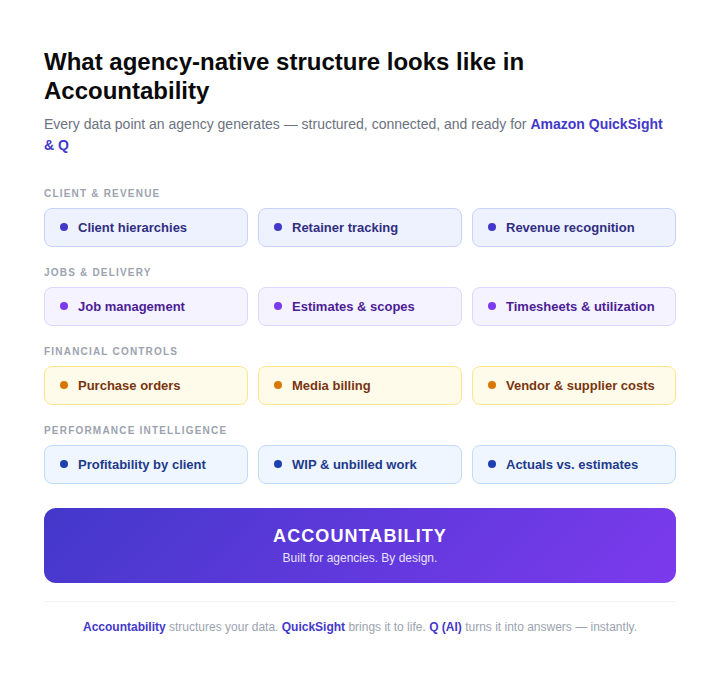
Accountability was designed from day one around how agencies work financially. Not adapted. Not configured. Designed. Every data point your agency creates has a home — and a clear link to every other data point that matters.

For example, the system connects client hierarchies to jobs, jobs to estimates, estimates to actuals, and retainers to monthly reconciliation. In addition, it handles purchase orders, media billing, timesheets, utilization, vendor costs, and revenue recognition — all in one place. As a result, you never need to export, reshape, or rebuild your data in a spreadsheet. It is already right. It is already yours.

agency finance software data structure in Accountability

When Intelligent Data Meets Intelligent AI

Amazon QuickSight is one of the most powerful business intelligence tools in the world. Amazon Q is its AI layer — it answers complex business questions in plain language, finds insights across your data, and helps your team move from question to decision in seconds. Together, they are a game changer.

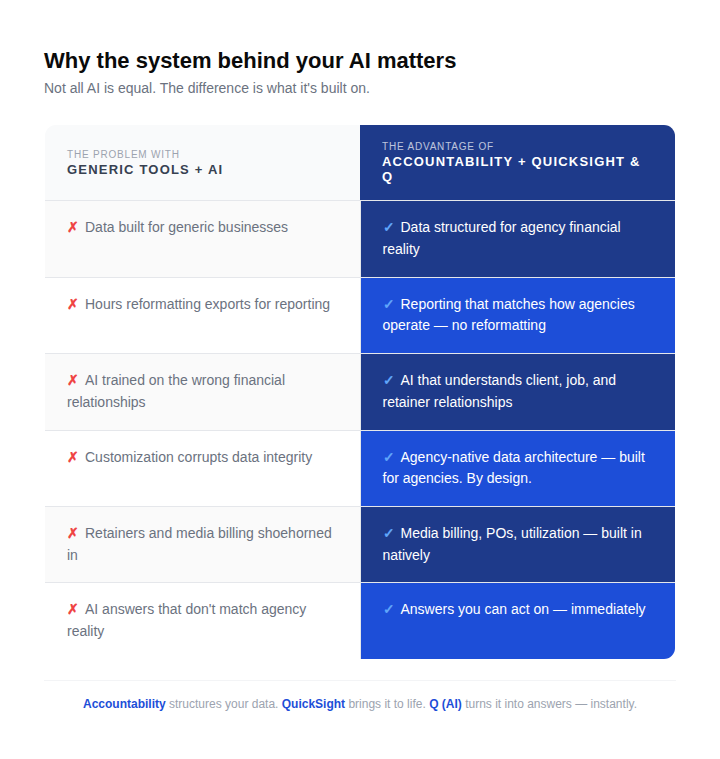
But here is what most vendors skip in their AI demos: QuickSight and Q are only as smart as the data they connect to. For instance, point them at messy, manually reworked data and they will give you fast, confident, wrong answers. Garbage in, garbage out — just with a better interface.

On the other hand, point them at Accountability’s data — clean, structured, and built around how agencies earn and spend — and something genuinely different happens.

Generic Tool + AI vs. Accountability + QuickSight & Q

agency finance software vs generic tools comparison

What This Looks Like in Practice

Imagine asking your system: “Which clients are trending toward unprofitability this quarter based on actual hours vs. estimated scope?” With a generic system, that question requires an analyst, an export, and a half-day in Excel. With Accountability and Amazon Q, that question gets answered in the same meeting it’s asked — because the data was structured to answer it from the moment it was entered.

Or consider: “Which open purchase orders are at risk of exceeding their job budgets?” That’s an agency-specific question with agency-specific data relationships. A system not built for agencies doesn’t even know how to hold that question, let alone answer it. Accountability does — and with QuickSight, it visualizes the answer instantly across your entire book of business.

Is Your Agency Finance Software Actually Intelligent?

Every software company is going to tell you they have AI. They’ll show you dashboards that look impressive and Q&A interfaces that feel futuristic. And some of it will even work — until you ask a question that only makes sense in the context of an agency, and the system looks back at you blankly.

Because AI can only reason about what it’s been given. And if it’s been given data that was never structured for your business model, it doesn’t matter how sophisticated the algorithm is. You’re asking a brilliant analyst to work with the wrong information.

The agencies that will win the next decade aren’t the ones who bolt AI onto broken data. They’re the ones who start with a foundation built right — and then amplify it with the best intelligence tools in the world.

That combination exists today. It’s Accountability with Amazon QuickSight and Q. Built for agencies. By design.

Stop Managing Data. Start Demanding Answers.

Your agency deserves a financial system that knows what a retainer is, understands how a job flows to an invoice, and gives AI the clean, structured data it needs to tell you the truth about your business — in real time. Stop settling for a system that was never built for you. The one that was built for you is already here..