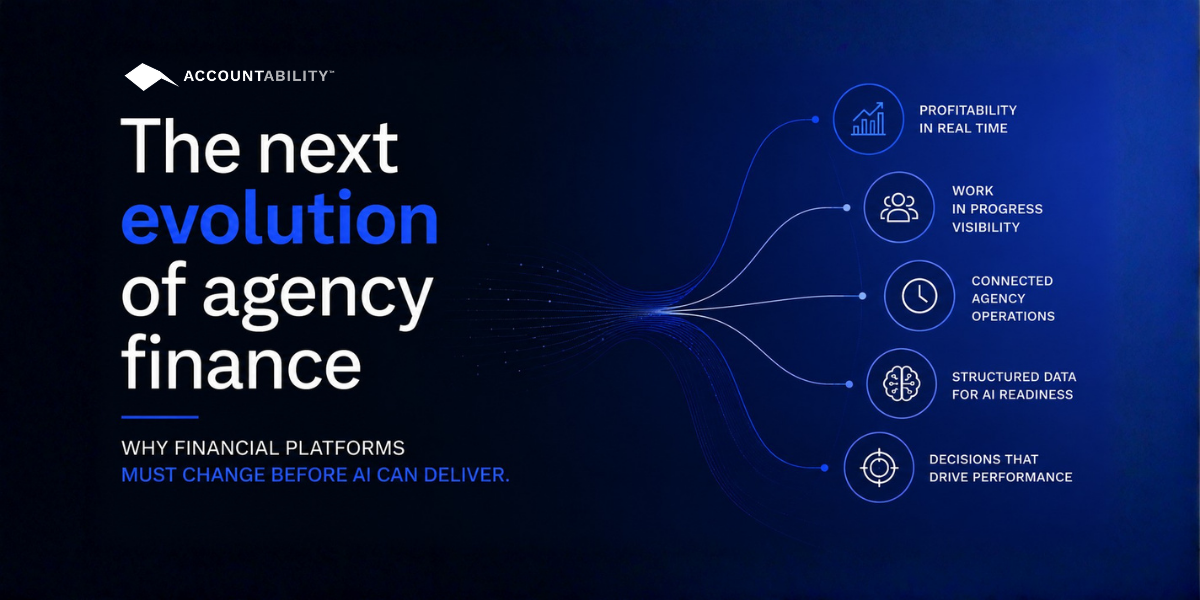
Why the next generation of finance requires more than another ERP
Executive Summary
Agency finance is entering a new era.
Artificial intelligence has changed the conversation around finance, but it hasn’t changed the underlying challenge. Finance leaders still depend on the quality of the financial platforms beneath them.
Research from McKinsey suggests that organizations realizing the greatest value from AI first strengthen their data foundations, governance, and operating models before scaling intelligent technologies.
For agencies, that challenge is especially acute. Profitability, work in progress, revenue recognition, and resource management are deeply interconnected. When agencies spread those financial relationships across spreadsheets, disconnected applications, and generic ERP systems, finance loses the visibility needed to make timely commercial decisions..
At Accountability, we’ve long believed agencies deserve a financial platform built around the way they operate—not one adapted from another industry. As finance evolves from reporting historical performance to delivering real-time operational insight, that distinction has become more important than ever.
This article explores why the next generation of agency finance requires more than another ERP. It requires a platform built around agency operations from the start.
The market has outgrown generic financial systems
For many agencies, finance technology has evolved through necessity rather than design. New requirements emerged, new tools were introduced, and additional reporting demands created more customization. Over time, enterprise ERP systems became increasingly complex, while specialist applications filled operational gaps. Finance teams created an ecosystem that required reconciliation across multiple platforms before they could establish a reliable financial position.
That model is becoming increasingly difficult to sustain.
Agency finance now demands continuous visibility rather than periodic reconciliation. Leadership teams expect to understand project profitability before billing is complete, identify margin erosion while projects remain active, and forecast financial performance using live operational data rather than historical assumptions.
These expectations expose the limitations of platforms that treat agency workflows as exceptions rather than core capabilities.
The challenge isn’t that finance teams lack technology. Nearly agencies have invested heavily in it. Instead, those investments have often produced disconnected financial ecosystems. Project management platforms manage delivery. Accounting systems record transactions. Spreadsheets bridge the gaps between them. Finance becomes responsible for reconstructing the relationships that should already exist inside the platform.
As agencies grow, that fragmentation becomes increasingly difficult to manage. Every reconciliation delays decision-making. Spreadsheets introduces another version of the truth. Every disconnected workflow reduces finance’s ability to influence commercial outcomes while work is still in progress.
Building intelligence begins with structure
Artificial intelligence has intensified the conversation around data, but structured financial information has always mattered.
Consider a finance leader asking a seemingly straightforward question:
“Which five clients are most at risk of margin erosion this month, and why?”
Finance leaders cannot find the answer in the general ledger alone.
It requires an understanding of estimates, approved budgets, time captured, supplier commitments, purchase orders, work in progress, billing status, revenue recognition, and historical project performance. More importantly, it requires those relationships to remain intact across the entire financial platform.
This is where many AI discussions become disconnected from operational reality. Organizations often evaluate intelligent capabilities before evaluating the quality of the information those systems will depend upon.
Microsoft’s 2026 Work Trend Index reaches a similar conclusion, highlighting that organizations continue to struggle with fragmented organizational knowledge and disconnected business data, limiting the value AI can deliver.
In practice, intelligence is only as effective as the financial foundation beneath it.
That is why Accountability has always viewed structured financial data as an architectural principle rather than a reporting feature. When agency data is organized consistently around jobs, clients, teams, and financial controls, every capability built on top of it becomes more valuable. Reporting becomes more accurate. Forecasting becomes more reliable. Automation becomes more trustworthy. Artificial intelligence gains the context required to explain, recommend, and eventually act with confidence.
Structured data is not preparation for AI.
It is the prerequisite for modern agency finance.
The financial platform becomes the intelligence layer
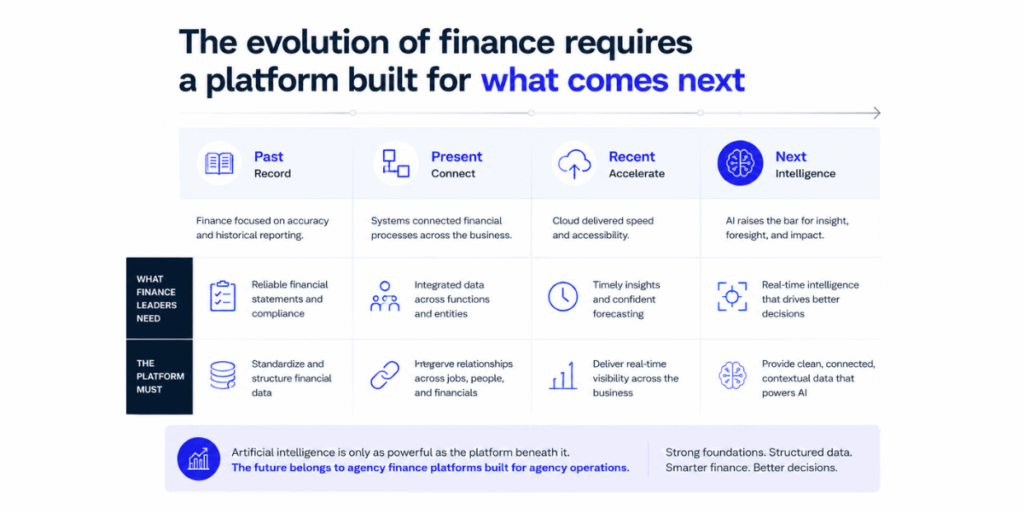
Historically, financial systems were designed to record transactions.
Tomorrow’s financial platforms will do considerably more.
They will connect operational activity with financial outcomes, preserving the relationships between project delivery, commercial performance, and accounting. Rather than acting as a passive system of record, the financial platform becomes the intelligence layer that supports every decision across the agency.
This shift changes the role of finance itself.
Instead of spending valuable time exporting reports, reconciling work in progress, and explaining historical performance, finance leaders gain the ability to identify emerging risks while there is still time to influence the outcome. Finance leaders can manage profitability proactively instead of measuring it retrospectively.
At Accountability, we’ve spent years building around a different belief.
We have never viewed agency finance as a collection of disconnected modules. We have always believed agencies deserve one connected financial platform where jobs, time, expenses, billing, approvals, profitability, reporting, and financial controls operate together. The platform doesn’t layer intelligence on afterward.. It is woven into the same operational foundation that agencies already depend upon every day.
This reflects a broader transition occurring across the market. Finance is moving beyond financial management toward financial intelligence—a shift that transforms finance from a reporting function into a strategic capability embedded within agency operations.
A different future for agency finance
The future of agency finance will not be determined by which organization adopts AI first.
Nor will it belong to the agency with the most dashboards or the largest ERP implementation.
It will belong to the agencies that invest in the financial platform beneath every decision.
For years, Accountability has been building toward that future. Long before the market began discussing AI readiness, we focused on agency-native workflows, structured financial data, real-time financial control, and an open architecture capable of supporting whatever comes next. Those decisions were not driven by technology trends. They were driven by a simple conviction that agencies deserve a financial platform built around the way they actually operate.
Today, that conviction has become more relevant than ever.
Agency finance has already entered its next evolution.
Finance leaders are no longer asking whether finance will become more intelligent.
Instead, they’re asking whether the platform beneath it is ready.
Continue the Conversation
The next generation of agency finance demands more than incremental improvements to legacy systems. It requires a financial platform designed around agency operations, structured for intelligence, and built to provide real-time control over profitability, work in progress, and financial performance.
At Accountability, we’ve spent years building for that future. If you’re evaluating how your agency will prepare for the next generation of finance, we’d welcome the opportunity to show you what’s possible.