Why AI and MCP Represent the Next Phase of Agency Technology
When we wrote the first lines of code for Accountability in 2007, the idea of an agency managing its financial information through a cloud-based platform was unheard of.
Today, we call it software as a service, or SaaS, and it is now widely accepted.
A few years later, I remember showing the CFO of a well-known agency an early release of Accountability. He liked what he saw until he asked what kind of server the system ran on.
When I explained that it was hosted on the internet, he laughed and told me that no agency would ever allow its financial information to be stored there.
I doubt he would remember that conversation today. But I remember it clearly.
I share the story because significant changes in how businesses operate often appear impractical before they become commonplace.
The case for cloud software was ultimately straightforward. Agencies needed a more accessible, scalable, and connected way to manage their financial operations. The technology changed, but the underlying business needs were clear.
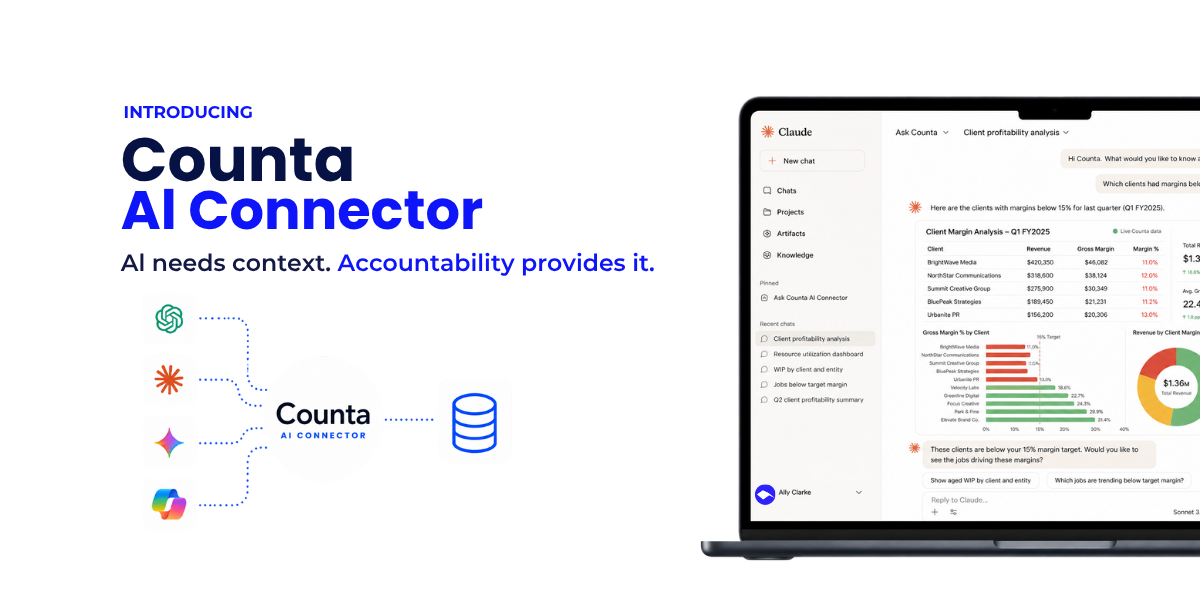
Nearly 20 years later, I believe agency technology is approaching another important transition. The Counta AI Connector is designed for that next phase, connecting AI tools to structured agency financial data within a governed framework.
The promise of connected systems
Once cloud software became established, I believed (or at least hoped) the next major advancement would come from open APIs.
No individual software platform can manage every aspect of an agency’s business. A finance platform is only one part of a much larger operating environment that may also include project management, CRM, media, HR, resource planning, expense management, and business intelligence systems.
APIs promised to allow agencies to connect those platforms so they could operate from a coordinated set of information rather than a collection of disconnected systems.
There has certainly been progress—APIs have made it easier to exchange information and automate individual processes. But they have not fully delivered the connected operating environment many of us imagined.
The reason is not simply technical.
Moving information from one API to another is often relatively straightforward from a technical perspective. The more difficult work is understanding what the information means within each business.
Every agency has its own organizational structure, terminology, workflows, client arrangements, approval processes, and financial rules. Two agencies may use the same project management platform, but they will often use it in entirely different ways. In many cases, different teams within the same agency use that platform differently, and we commonly see a single agency using four or five different project management platforms.
As a result, an integration designed for one agency rarely works for another without considerable modification. Even an integration built for a specific agency can struggle when the underlying process is inconsistent or not clearly defined.
The real challenge is not moving data between systems; it is preserving the business context behind that data so the right action can follow.
How AI and the Model Context Protocol (MCP) Change Agency Finance
After nearly 20 years, I believe the combination of artificial intelligence and the Model Context Protocol (MCP) creates a practical opportunity to address many of the limitations that have prevented APIs from delivering their full promise.
Our CEO, Judd Rubin, first raised MCP in an internal conversation. He did not present it as another technology in search of a use case. He was thinking about the business problem it could solve and the broader opportunity it could create for Counta.
In practical terms, MCP gives AI tools a governed way to access and work with business systems, so they can act with context rather than simply respond in isolation.
Judd shared a simple three-layer model:
- Counta is the system of record – the source of financial truth, controls, and governance.
- MCP servers are the system of connection – giving approved AI tools a standardized way to access Counta’s governed data and capabilities, alongside the other systems an agency uses.
- Large language models are the system of understanding – interpreting intent, explaining information, and helping people make better decisions.
That framing was immediately compelling. Counta did not need to surrender its role as the trusted financial foundation, and an LLM did not need to become the system of record. Each layer could do what it was best suited to do.
More importantly, it gave structure to a problem I had been thinking about for years: how to allow Counta to work intelligently with the many other systems an agency depends on, without building another brittle, custom integration for every workflow.
From there, we moved quickly. Our team translated the idea into Counta’s architecture, determined how MCP could operate within our existing permissions and controls, and turned it into something powerful and practical. The result is the Counta AI Connector, built using the Model Context Protocol (MCP).
Why AI Makes MCP Different
MCP is not, by itself, the breakthrough. It provides a standardized way for an AI tool to connect securely to external platforms and data sources. The more significant change is what happens when that connection is combined with an AI model capable of interpreting different terminology, structures, and user intent.
In a traditional integration, every field mapping, business rule, and workflow variation generally needs to be anticipated and coded in advance. That approach works reasonably well for simple, predictable exchanges of information. It becomes far more difficult when two systems are designed for different purposes, or when each agency uses the same platform differently.
With AI, more of that interpretation can happen in context. Instead of building a separate, fixed integration for every possible question or workflow, an AI tool can use information across connected systems to help understand what the user is trying to accomplish.
AI Still Depends on Structured Data and Governance
This does not make system design or integration challenges disappear. Agency data still needs to be structured. Permissions still need to be enforced. Financial rules still need to be applied consistently. People still need to review and approve important decisions.
AI and MCP may therefore allow APIs to deliver more of their original promise: enabling different platforms to work together with context, without requiring a custom development project for every new use case.
Why connection must come before conversation
There is an understandable temptation for every software company to define its AI strategy by adding a chatbot to its product. But simply attaching a chat window to an existing application is not the same as building embedded intelligence.
We see an important role for intelligence embedded directly within Counta. Over time, AI should become part of the experience itself—surfacing relevant information in context, identifying issues earlier, recommending appropriate next steps, and reducing the manual work required to complete everyday processes.
That is the strategic future the Counta AI Connector is designed to enable.
AI Needs Context Beyond a Single Application
A chatbot confined to Counta would only understand the information available within Counta. Agency work rarely happens inside a single platform. It spans calendars, project management systems, CRM, media platforms, HR and resource tools, and financial systems.
Consider time entry.
A user could open Counta and ask a chatbot to add five hours to their timesheet for a job they are working on. That may be slightly easier than completing the entries manually, but the assistant still lacks the broader context needed to understand how the person spent their time.
A more valuable workflow would allow the user’s AI tool to review their calendar, prepare a draft timesheet, associate the time with the appropriate clients and jobs, and present it for approval before sending the final entries to Counta.
Counta AI Connector Creates the Foundation
That is why we began with the Counta AI Connector.
The connector creates a governed foundation through which AI can work with Counta alongside the other systems agencies rely on. It supports the AI tools agencies use today while also creating the foundation for more deeply embedded intelligence within Counta in the future.
Today, approved AI tools can use Counta AI Connector to analyze client and job profitability, prepare aged WIP, resource utilization, and financial summaries, retrieve operational records, and complete supported actions such as creating and updating time entries—all within Counta’s established permissions and controls.
This is not a choice between connected AI and embedded AI. The connector helps ensure that the intelligence we ultimately embed is not isolated within our own platform but informed by the broader context in which agencies operate.
The importance of an agency financial foundation
AI can only be as useful as the information it can access and understand.
This is especially important in an agency environment, where financial performance depends on the relationship between many different parts of the business.
Revenue needs to be understood alongside estimates, time, external costs, billing, work in progress, resource allocation, and contractual arrangements. Client profitability may need to be analyzed across offices, entities, service lines, or currencies. A project status in one system may have a direct financial consequence in another.
Giving an AI tool access to disconnected data tables does not automatically give it an understanding of those relationships.
Counta was designed specifically around the financial and operational requirements of agencies. The Counta AI Connector builds on that foundation by allowing AI tools to work with information that is already structured around the way agencies operate.
This creates the potential for more meaningful questions and workflows, including:
- Reviewing client and job profitability across offices or entities
- Identifying work that is approaching or exceeding its approved estimate
- Exploring the relationship between resource plans, time, revenue, and margin
- Preparing summaries for client or management reviews
- Retrieving operational records without navigating multiple screens
- Supporting controlled workflows using information from more than one platform
The connector does not replace the need for sound financial management or thoughtful operating processes. It makes that foundation more accessible to the tools that agencies are beginning to use every day.
Better technology still requires better judgment
AI will make it possible to build software and automate workflows more quickly. But speed has never been the only—or even the most difficult—part of creating useful technology.
The most valuable work remains understanding the real business problem.
An agency may ask for an integration between two systems, but the integration itself is not usually the objective. The agency may be trying to eliminate duplicate entry, improve visibility, shorten its month-end close, strengthen project accountability, or understand profitability earlier.
Building what someone initially asks for is not the same as solving what they actually need.
AI does not remove the need for business analysis, product judgment, or clear system design. In many ways, it makes those capabilities more important. When more can be built more quickly, agencies and technology providers need to be even more disciplined about deciding what should be built, how it should work, and where human oversight remains essential.
The next phase
Cloud software made business platforms more accessible. APIs made them more connectable. AI and MCP now have the potential to make them work together with greater context.
This model gives us a clear architecture for the next phase: extending Counta beyond its role as a system for recording transactions to a financial management platform designed to support better decisions and informed action.
Counta remains the trusted system of record. MCP extends that financial context across the agency’s ecosystem. Large language models help people interpret, explain, and act on information. None replaces the other; together, they expand what the platform can enable.
When I founded Accountability, the goal was to give agency finance teams the tools they needed not only to maintain their financial records, but also to contribute more strategically to the agency’s growth and profitability.
That goal has not changed. The next phase is to make the agency’s financial foundation available wherever informed decisions and operational work happen: across the systems, data sources, and AI tools the agency chooses to use.
The future of agency technology will not be one platform attempting to do everything. It will be an environment where the tools and systems in the agency tech stack work together with the context to be useful, the flexibility to adapt, and the control to be trusted.