As an agency, you strive to deliver the best results to your clients. One question you may have considered is whether an all-in-one system that claims to do it all is the best choice for your agency. On the surface, it may seem like a cost-effective solution, but is it really efficient?
Agencies have unique financial needs, and a financial platform built specifically for them will address those needs. With a financial platform designed for agencies, you can have full control and insights on revenue, expenses, and cash flow. This ensures that your agency’s finances are always under control, and you can be proactive about addressing any issues that arise. Better financial control gives you the peace of mind to focus on growing your agency and delivering quality services to your clients.
At Accountability, we take pride in our customer-centric approach, which is the foundation of everything we do. We understand that each agency is unique, and our responsibility is to provide them with the best financial management platform that meets their specific needs. We aim to optimize their financial operations, making it possible for them to focus on what they do best.
At Accountability, we take pride in our customer-centric approach, which is the foundation of everything we do. We understand that each agency is unique, and our responsibility is to provide them with the best financial management platform that meets their specific needs. We aim to optimize their financial operations, making it possible for them to focus on what they do best while we handle the financial aspect. In this blog post, we’ll dive into how our customer-centric approach helps to revolutionize the financial management industry.
Understanding the Needs of Our Customers
Our approach to customer-centricity begins by understanding the unique needs of our customers. We listen carefully to them and keep an open line of communication, taking notes of their requirements and preferences. This helps us tailor our platform to meet their specific needs and preferences. By consistently putting our customer’s needs first, we are more likely to provide them with valuable services that help them grow their business.
A Platform Configured For Our Customer’s Success
One of the things that sets Accountability apart is our configurable platform. Our platform is designed in a way that aligns with the way our customers’ agencies work. We take into account their budgeting, reporting, and tracking needs and work with them to configure the platform to suit their requirements. This level of customization allows our customers to focus their energy on tasks that will drive their business’s success.
An Open Architecture That Connects With Existing Systems
We understand that different agencies employ different software and tools to manage their businesses. That’s why our platform has an open architecture, making it easy for our customers to connect it with their other vital tools. Our platform becomes a financial hub that integrates seamlessly with existing tools, enhancing their workflows. This ensures that our customers remain competitive in the market.
A Partner to Our Customers
We see our clients more as collaborators and partners rather than customers. Our team works closely with our customers, understanding their business goals and aligning the platform to deliver success. We provide comprehensive support throughout the implementation stages and post-implementation. This ensures that our customers get the best value from our platform and see a measurable impact on their bottom line.
Evolving to Meet Dynamic Needs
Our customer-centric approach means that we understand that our customers’ needs will shift, grow and evolve over time. We keep a pulse on the market and continuously bring new features and product updates to our platform to stay ahead of the curve. This ensures that we keep our customers competitive in their market and remain a valuable partner in their business growth.
Our customer-centric approach puts our customers’ needs at the center of what we do. Our customizable platform is configured to deliver success for each customer we serve. As a partner in their business growth, we provide comprehensive support and remain committed to evolving our platform to meet our customer’s dynamic needs. With Accountability, our customers can be confident they have a financial management strategy that will help their business to thrive.
In any organizational workflow, there are multiple stages where tasks are executed and decisions are made. In the context of accounting, we often come across the terms #approving and #posting. For anyone who isn’t familiar with accounting terminology, these two terms might sound interchangeable. However, there is a significant difference between these two concepts.
In this episode of #mondaybytes, Joanne explains the difference between approving and posting a transaction.
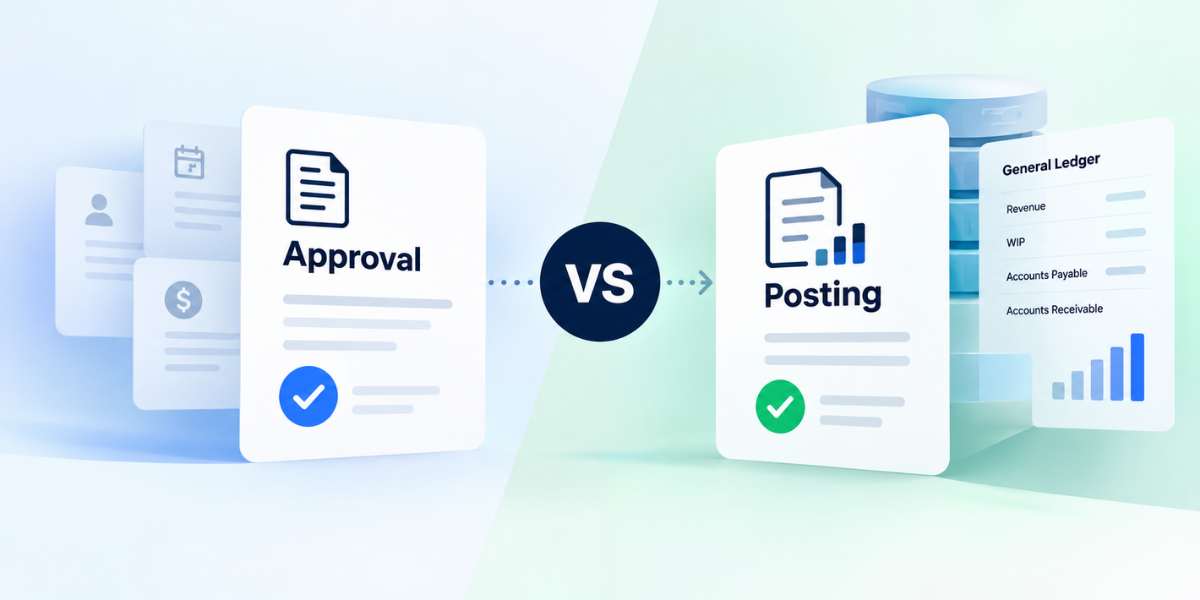
Approving vs posting may sound like a technical accounting distinction, but for agencies, the difference directly affects financial control, WIP, profitability, and reporting.
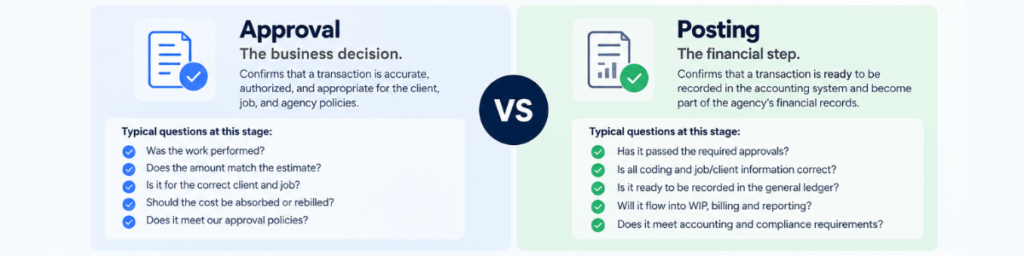
Approval confirms that a transaction should happen. Posting confirms that it is ready to become part of the agency’s financial records.
That distinction matters because agency finance rarely follows a simple transaction-to-ledger path. Timesheets affect WIP. Expenses need to reach the right job and client. Supplier invoices may require project or department approval. Client billing can affect revenue recognition and profitability reporting.
When approval and posting are treated as the same step, finance teams can lose an important layer of control between operational activity and the financial statements.
What is approval in accounting?
Approval is the business decision that a transaction is accurate, authorized, and appropriate.
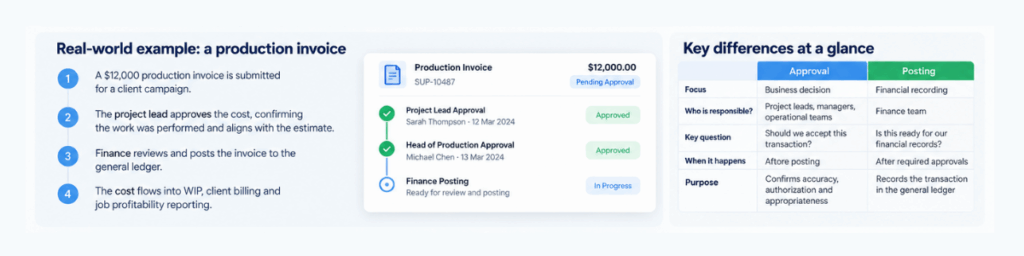
Consider a $12,000 production invoice related to a client campaign.
Before finance records that cost, someone may need to confirm:
The work was actually performed.
The amount agrees with the estimate or purchase authorization.
The expense belongs to the correct client and job.
The agency should absorb the cost or rebill it to the client.
The transaction complies with the agency’s approval policies.
That is approval.
The person making that decision does not necessarily need responsibility for the agency’s general ledger. Their job is to confirm the business context behind the transaction.
What does posting mean?
Posting is the financial step.
Once a transaction has passed the required approvals, finance determines whether it is ready to be recorded in the accounting system.
Posting makes the transaction part of the agency’s financial records and allows it to flow into the reporting processes that finance depends on.
The simplest distinction is:
Approval asks: Should we accept this transaction?
Posting asks: Is this transaction ready to affect our financial records?
Separating those questions creates an important control point.
Why Approving vs Posting Matters for Agencies
Agency finance is unusually dependent on operational data.
A single client engagement can involve employee time, freelance costs, media, production expenses, purchase orders, supplier invoices, client billing, WIP, and revenue recognition.
Those transactions do not necessarily arrive in the order finance would prefer.
Imagine that a creative team incurs a $15,000 production cost against a client job. The project lead knows whether the work was authorized. Finance knows how the cost should be treated in the accounting records.
Those are different responsibilities.
A strong financial workflow allows the project lead to approve the business transaction while preserving finance’s control over when and how it is posted.
Approval is also about routing the right decision to the right person
As agencies grow, a single approval rule becomes increasingly difficult to manage.
A $75 employee expense should not necessarily follow the same approval path as a $75,000 production invoice.
Different transactions may require approval based on:
Employee or department
Client
Job
Transaction type
Dollar threshold
Manager
Office or entity
This is where financial workflow design becomes important.
The objective is not to add approvals everywhere. It is to put the appropriate control at the point where someone has enough context to make the decision.
The cost of getting the workflow wrong
Poorly designed approval processes usually create one of two problems.
Too little control: Transactions reach the financial records before the right people have reviewed them. Finance then spends time investigating, correcting, or reversing activity.
Too much control: Every transaction follows the same approval chain, creating bottlenecks that delay expenses, billing, WIP, and month-end reporting.
The goal is therefore not simply “more approvals.”
It is a workflow that balances control, speed, and accountability.
What a good agency approval and posting process should provide
Agency finance leaders evaluating their current process should ask:
Can approval authority vary by transaction type, value, job, client, or employee?
Can multiple or sequential approvals be required when appropriate?
Can finance clearly see which transactions are approved but not yet posted?
Is there a reliable record of who approved a transaction?
Can operational managers approve activity without giving them unnecessary accounting access?
Do approved transactions flow cleanly into WIP, billing, job profitability, and financial reporting?
If answering those questions requires spreadsheets, email chains, or manual reconciliation, the problem may be larger than the approval process itself.
How Counta approaches agency financial workflows
Counta is built specifically around the financial workflows of agencies.
Rather than forcing agency operations into the structure of a generic ERP, the platform connects jobs, clients, time, expenses, WIP, billing, revenue, and financial reporting within the same financial system of record.
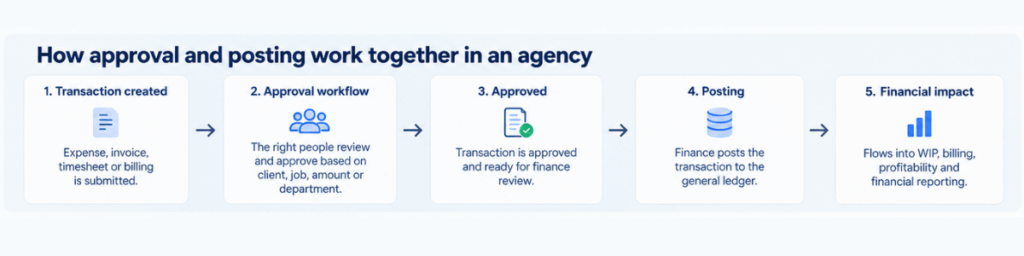
That includes configurable approval workflows. For expense claims, for example, agencies can use approval scenarios to determine required approvals based on the transaction and can establish sequential approval paths when more than one review is required.
Once the required approvals are complete, the transaction can move to finance for review and posting.
The result is a clearer separation between the people responsible for authorizing agency activity and the finance team responsible for protecting the integrity of the financial records.
See how agency-native financial workflows work
If your finance team is spending too much time chasing approvals, reconciling transactions, or determining what is ready to post, the underlying issue may be the system connecting agency operations to finance.
See how Counta gives agency finance teams control over jobs, WIP, expenses, billing, profitability, and financial reporting in one platform.
Today’s fast-paced agency is characterized by constant changes, activities, and progress. Agility is essential for agencies of all sizes to stay ahead of the competition. In the creative services industry – where agencies cater to a wide range of clients, projects have varying scopes, priorities, and tight timelines – dynamic approval is critical.
Approval workflows are integral to project management, time management, and estimating costs. Workflow processes can be complicated, and decision-making needs to be fast. Traditional approval workflows or lack thereof, can lead to over or under estimated costs, incomplete tasks, and missed deadlines. With dynamic approval, the decision-making process is sequential and streamlined, ensuring that decisions are made quickly at the right time.. Throughout the process, alerts, notifications, and reminders are sent to stakeholders to ensure that nothing falls through the cracks.
Flexibility is key
Agencies often require tailored workflows to suit the client or project at hand. A flexible approval process can be modified to cater to specific transactions that need approval. A dynamic approval workflow will allow an agency to define exceptions and specific rules to direct the approval requests accordingly. More control over the workflow means increased efficiency and minimal errors.
The ability to integrate with current software
A dynamic approval process can be integrated with existing software like project management, reviews, and asset management systems. With a dynamic approval workflow, agencies no longer rely on slow and inefficient manual processes, reducing the risk of errors, delays, and miscommunication.
Increased accountability
A dynamic approval workflow creates transparency, encourages collaboration, and provides accountability. Every team member knows their role within the process, reducing the risk of missed deadlines or communication breakdowns. Additionally, dynamic approval workflows create traceability for compliance and audit purposes, while automatic monitoring ensures that workflows are followed correctly.
Better customer experience
For agencies, client satisfaction is key. Dynamic approval workflows lead to faster delivery of projects, quicker response times, and more flexibility to accommodate urgent requests. A streamlined process improves client engagement and trust, producing better customer experiences and satisfaction rates.
Dynamic approval workflows are a game-changer for agencies that require agility, flexibility, and quick decision-making on various projects. Automation and a configurable workflow increase efficiency, reduce errors, and improve accountability across all team levels.
Let’s chat about how dynamic approval workflow can improve your business. Click hereto learn more about Accountability.
Today’s fast-paced agency is characterized by constant changes, activities, and progress. Agility is essential for agencies of all sizes to stay ahead of the competition. In the creative services industry – where agencies cater to a wide range of clients, projects have varying scopes, priorities, and tight timelines – dynamic approval is critical.
Working in New York City in the summer can be an exciting experience. There’s always something to do with so much going on, from outdoor concerts to festivals and events. However, the heat and humidity can be brutal, making working in the city challenging. In this blog post, we’ll discuss some tips on surviving the summer heat and making the most of your time working in New York City.
Dress appropriately: The first step to surviving the summer heat is to dress appropriately. Wear light-colored, loose-fitting clothing made from breathable materials like cotton or linen. Wear a hat and sunglasses to protect your face and eyes from the sun. It’s also important to wear sunscreen, even if you are only outside for a short period.
Stay hydrated: The next step is to stay hydrated. Drink plenty of water throughout the day, even if you don’t feel thirsty. Avoid caffeine and alcohol, which can dehydrate you. Keep a water bottle at your desk, and if you’re out and about, take advantage of the many drinking fountains throughout the city.
Take breaks: Working long hours in the heat can be exhausting, so it’s important to take breaks. If you work in an office, take a break and go outside for a walk during your lunch break. If you’re out for an extended time, take frequent breaks in the shade or indoors to rest and cool off.
Use public transportation: New York City has an excellent public transportation system, including air-conditioned buses and trains. If your workplace is near a subway station, take advantage of it. If you have to drive, try to park in a covered garage to keep your car cool.
Find indoor activities: Finally, if you’re looking for a break from the heat, there are plenty of indoor activities to enjoy. Visit a museum, catch a movie, or shop in an air-conditioned mall. New York City has something for everyone, so take advantage of all the city offers.
Working in New York City in the summer can be challenging, but with these tips, you can make the most of your time in the city while staying cool and comfortable. Remember to dress appropriately, stay hydrated, take breaks, use public transportation, and find indoor activities. With some planning and preparation, you can enjoy all New York City has to offer, even during the year’s hottest months. So, get out there and have some fun!
June is Pride Month when the LGBTQIA+ community celebrates and honors its journey towards equality. It’s a time for reflection, education, advocacy, and, more importantly, to amplify the voices of those pushing for progress. As part of this year’s Pride Month celebrations, we highlight Michael Miguel, our Marketing and Sales Operations director.
What does “pride” mean to you? How do you celebrate pride?
Pride has always been an essential part of being a part of the LGBTQIA+ community. Pride means embracing who you are and being confident in your skin. It’s about recognizing and celebrating the unique qualities and experiences that make us who we are.
When it comes to celebrating pride, there are many ways to do so. Some people attend pride parades and festivals, while others participate in community events or volunteer with LGBTQIA+ organizations. Celebrating love without fear of judgment or discrimination is incredibly important for a same-sex couple with a child. Pride represents the ability to embrace and express love in all its forms. It’s about holding hands with your partner in public without worrying about negative reactions. Celebrating pride can take many forms, from attending events to simply being proud and sharing it with others. Taking our son to show him off in public is a beautiful way to demonstrate our pride and love. Our family deserves to be celebrated and supported all year round.
What challenges do members of the LGBTQIA+ experience in the workplace, and what can companies/allies do to support the LGBTQIA+ community
It’s unfortunate that members of the LGBTQIA+ community still face challenges in the workplace. Discrimination, stereotypes, and a lack of inclusivity can make it challenging to feel comfortable being authentic. I remember having to hide who I was at work and conform to what was perceived as standard. It was even worse when I overheard negative remarks about the LGBTQIA+ community.
However, companies and allies can make a difference by promoting an inclusive work environment. This can be achieved through employee resource groups and training. It’s about making sure that everyone feels seen and heard and celebrating the uniqueness that diversity brings.
I feel lucky to work for a company like Accountability. Here, we embrace diversity and encourage authenticity. It’s a safe place where I feel supported every single day.